


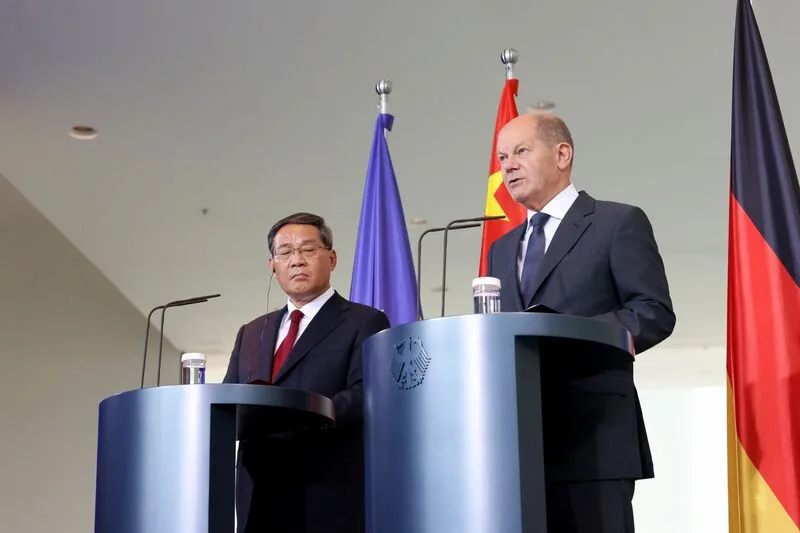


Germany and China have reached an initial agreement to strengthen their economic ties and join forces to tackle climate change, despite growing tensions between the two countries. The talks between Chancellor Olaf Scholz and Chinese Premier Li Qiang were attended by senior ministers from both governments. While they each delivered a statement outlining areas where their countries can deepen cooperation, they did not provide much detail or take any questions from reporters.
The German government is set to publish an updated China policy soon, which will frame its view of China as a rising rival and competitor. However, officials in Berlin recognize that global issues like climate change cannot be solved without Chinese involvement. Scholz emphasized the importance of keeping communication channels open and requested that China use its influence over President Vladimir Putin to help end the war on Ukraine. He also warned against China sending weapons to Russia.
Scholz also made references to the need for a level playing field for German companies operating in China, for respect for human rights, and for journalists to have more freedom of access to China. "As big CO2 emitters, Germany and China have a special responsibility in the fight against climate change," Scholz said. Representatives from the two countries also signed an initial agreement on exploring closer cooperation on electric and hydrogen mobility.
Both leaders attended a German-Chinese business conference where ministers signed an initial agreement to establish a dialog and cooperation format on fighting climate change and accelerating the green transformation. Several memoranda of understanding were also signed by Chinese officials and company executives from Mercedes-Benz AG, Volkswagen AG, BMW AG and Siemens AG.
These talks come on the same day that Scholz's government published its latest domestic intelligence report, which included China on a list of countries "with massive spying activities" in Germany, alongside Russia, Iran, and Turkey. The report claims that China has been operating a comprehensive system of technology and know-how transfer to advance its civilian and military development and specifically targeting emerging technologies.
The German chancellor received criticism from opposition lawmakers for holding a news conference with Li without allowing reporters to ask questions. One foreign policy spokesperson for the conservative CDU/CSU alliance called it unacceptable that he couldn't stand up for democratic values when dealing with China and that reporters should have been allowed to ask critical questions. Despite these criticisms, the preliminary agreement between Germany and China shows a mutual willingness for deeper cooperation on climate change and economic ties.