


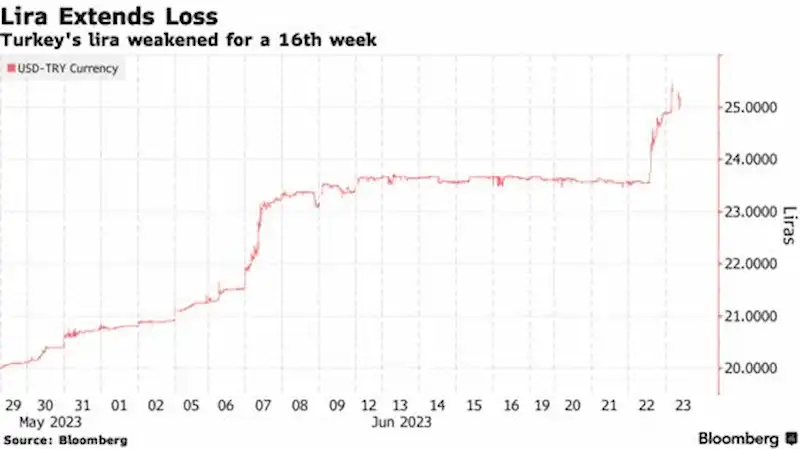


Turkey’s Treasury and Finance Minister, Mehmet Simsek, has reiterated his support for gradual changes in economic policies to restore financial, price and macroeconomic stability. His comments followed the Turkish central bank's decision this week to increase interest rates less than expected to curb a slide in the lira. The currency initially fell 5.7% following the rate adjustment, and is down 17% this month, though it has bounced back in the past two days. Simsek also tweeted: “Policy framework based on the principles of market economy, free foreign-exchange regime and open economy will ensure significant capital inflow to Turkey."
The lira has been devalued significantly since President Erdogan’s victory, despite being closely managed. Though traders anticipate further depreciation, derivatives reveal that they had expected a bigger interest rate hike than the one-week rate increase implemented. It is feared that the slower-than-expected adjustment will result in a steep money-market curve, with the one-month deposit rate already at 27% and the three-month rate at 40%.
Deutsche Bank strategist, Christian Wietoska, commented: “The hawkish and committed press statement was not enough to convince investors and was outweighed by the under-delivery on interest rate hikes. This does not make it easier for the central bank, and risks of chasing the market – rather than taking the initiative over the upcoming months – have increased."
In the country's longest losing streak since 1999, the lira has been on a path of decline for the past 16 weeks. However, the gradual approach was welcomed by stock investors, with shares in Istanbul-listed banks rising as much as 5.2% on Friday. The slow change in foreign exchange policy might give banks time to adjust to holding low-yield government bonds, said Enver Erkan, chief economist at Dinamik Yatirim. Goldman Sachs economists, Clemens Grafe and Basak Edizgil added: “It will be difficult to fully float the lira without having an interest rate anchor."