


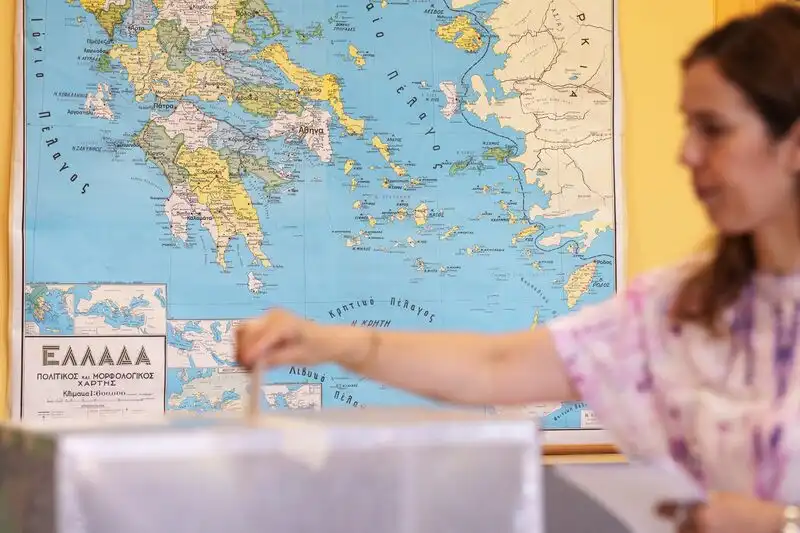


Greeks head to the polls on Sunday for the second time in just over a month to decide who will govern the country for the next four years. The previous election on May 21 indicated that former Prime Minister Kyriakos Mitsotakis and his center-right New Democracy party are likely to emerge victorious. However, the challenge remains whether he will be able to assemble a single-party government or once again fall short of securing a parliamentary majority.
A coalition government seems out of the question this time as none of Greece’s party leaders want to work with each other. Hence, if Mitsotakis can’t govern alone, a third election may be held in about a month’s time. Mitsotakis was Greece’s premier from 2019 until May 24, when Ioannis Sarmas was appointed as caretaker prime minister following the indecisive election.
One of the most crucial issues this time is whether Greeks will actually go and vote. However, the participation rate until 10:30 am was only 11.3%, and everyone is hoping that more voters will come out to cast their ballots.
Stock and bond markets rallied after the May vote as investors anticipated a probable Mitsotakis win on Sunday. This outcome may pave the way for a stable government that can continue the reforms and fiscal path already in place. In May, New Democracy won 40.8% of the vote, almost twice the 20.7% of former Prime Minister Alexis Tsipras’ leftist Syriza party, and the largest margin of victory of any party since 1974.
If Mitsotakis fails to secure an outright parliamentary majority, the parties will once again need to find common ground in order to form a coalition government. And if all party leaders stick to their current position, then Greeks will be back at polling stations in about a month. However, if the Harvard MBA graduate repeats his party’s success in May, then his party is likely to get at least 151 members in the 300-seat parliament, even if additional parties pass the 3% threshold necessary to enter parliament.
Voting sites will be open from 7 am to 7 pm, local time, on Sunday, and the first exit polls should follow soon afterward. If a third election is needed, market momentum may reverse, even as Greece tries to regain the investment-grade status it lost 13 years ago. Therefore, the election outcome is closely watched not only by Greeks but also by investors worldwide who are looking for a stable government that can ensure the continued reform and economic progress of the country.