


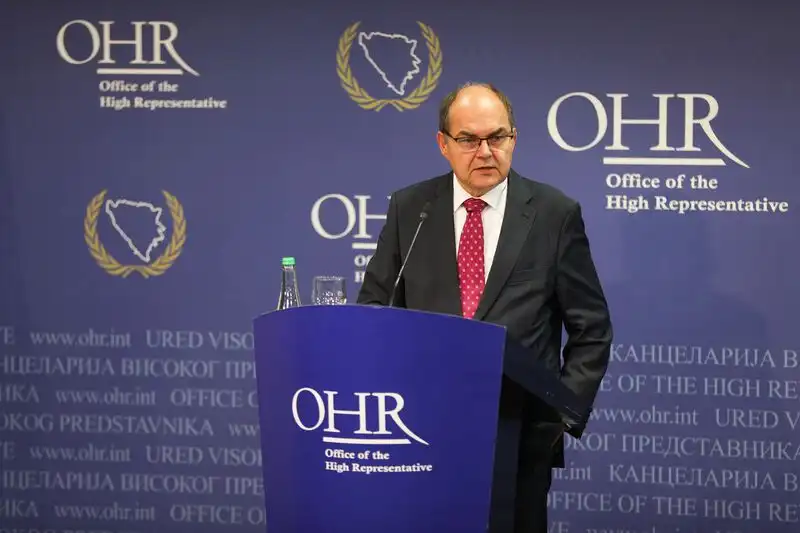


Bosnia-Herzegovina's international overseer, Christian Schmidt, has revoked two laws adopted by ethnic Serbs that were deemed unconstitutional, marking yet another standoff that threatens the fragile postwar balance in the country. Schmidt, who holds the position of Western-backed envoy with the power to change legislation that undermines Bosnia's complex power-sharing structure, nullified the laws enacted by lawmakers in the Republika Srpska entity. These laws denied the authority of the Constitutional Court in Sarajevo, according to Schmidt's office statement released on Saturday.
Disputes over governance have historically served as fuel for Serb separatism, with Milorad Dodik, the leader of Republika Srpska, even making threats of declaring his region independent. The current dispute revolves around control of state assets, as Serbs defy central authorities, including the Constitutional Court.
Schmidt firmly stated, "Entity parliaments do not have the authority to override the Constitutional Court of Bosnia and Herzegovina." He also warned of penalties for anyone who undermines the provisions of the 1995 Dayton peace agreement, which ended the war in Bosnia.
The U.S. Embassy in Sarajevo supports Schmidt's decisions and cautions against any "unconstitutional and deliberate attacks" on the peace agreement's provisions. They emphasize that there will be consequences for such actions.
Dodik, who is already under sanctions from the United States and the United Kingdom and maintains close ties with the Kremlin, reiterated his opposition to the court's authority and Schmidt's appointment as High Representative in 2021. He argues that the appointment lacks full approval from the United Nations Security Council.
The Bosnian War erupted in 1992 following the disintegration of Yugoslavia, resulting in a brutal conflict between Serbs, Croats, and Muslim Bosnians. The war claimed the lives of over 100,000 people, ultimately leading to the semi-division of Bosnia-Herzegovina into the Serb-controlled entity and the other half shared by Muslims and Croats, connected by a central government in Sarajevo.