


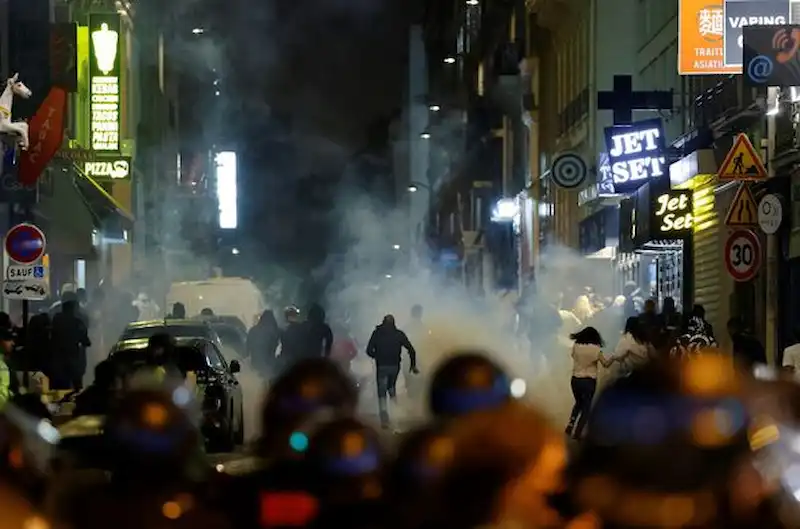


Street unrest in France has begun to ease after nearly a week of riots and looting that erupted following the killing of a teenager by a police officer. The incident, which involved the shooting of 17-year-old Nahel, who was of North African descent, has brought to light deep-seated tensions in ethnically diverse suburban neighborhoods. The violence has somewhat subsided, with the number of arrests dropping to 157 overnight, compared to over 700 the previous night. However, the situation remains delicate, and the government has deployed thousands of police officers, special forces, and armored vehicles to contain the clashes that have resulted in extensive damage to public buildings and shops in cities such as Paris, Marseille, Lyon, and Strasbourg.
To address the ongoing crisis, President Emmanuel Macron is scheduled to hold meetings with the heads of the Senate and the National Assembly, as well as meet with French mayors. Meanwhile, the Interior Minister, Gerald Darmanin, has provided some concerning statistics, revealing that the average age of those arrested is 17, with some as young as 12 involved in setting fires. Additionally, about 60% of those arrested have no prior criminal record. Darmanin emphasized that the responsibility for addressing such behavior should lie partially with families and parents, stating that it is not solely the duty of the police, mayors, or the state to resolve these issues.
This wave of unrest poses another challenge for Macron, who had already faced significant opposition and protest over his pension reforms before the COVID-19 pandemic. The image of riot police clashing with protestors further tarnishes France's global reputation and adds to the economic strain faced by the government. Some experts argue that Macron needs to develop robust policies that address the underlying problems faced by the disaffected youth in France, as there is concern that he may not fully grasp the gravity of the issue.
While the boy's grandmother has called for calm, the riots highlight the deep divisions within French society. Violent clashes, particularly in Marseille, have caused extensive damage to shopping malls, supermarkets, banks, and stores. As countries like the UK issue travel warnings for France, the political opposition has seized upon this crisis to criticize the government's failure to ensure public safety and reduce economic disparities.
In one particularly alarming incident, the burning car of a Paris suburb mayor was rammed into their home, prompting authorities to investigate the incident as attempted murder. Labor unrest and street demonstrations have become more intense in recent years, exemplified by the Yellow Vest movement, which caused widespread property damage. The national unrest has even caused Macron to postpone his state visit to Germany, with Chancellor Olaf Scholz expressing his disappointment over the clashes.
The burial of Nahel took place in Nanterre, his hometown, where he was shot at close range in a car. The police officer responsible for the shooting has been charged with murder and is currently in pre-trial detention. The officer's lawyer has argued that the officer believed he had to use lethal force.
The situation in France remains fragile, and it is essential for the government to address the underlying issues of racism, inequality, and disaffection among the youth. A comprehensive and nuanced approach is needed to resolve this crisis and bridge the deep divisions within French society.