


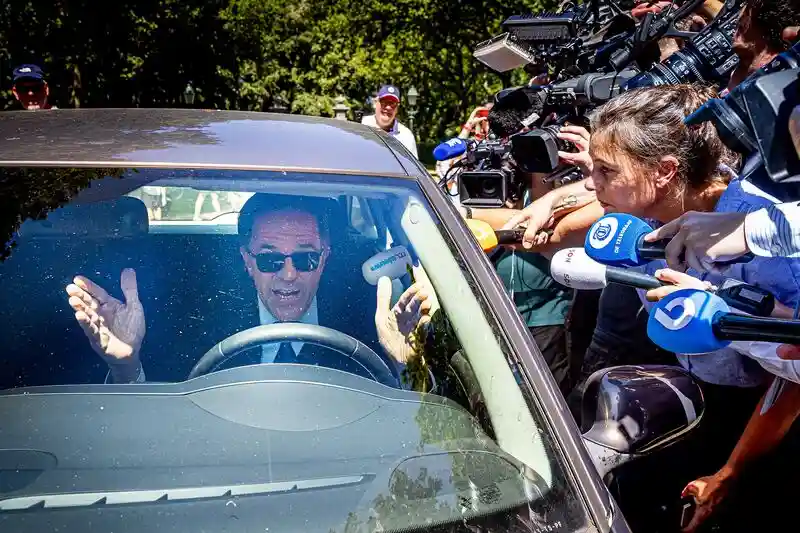


In a shocking turn of events, the government of Dutch Prime Minister Mark Rutte has collapsed amidst intense disagreements over migration policy. Rutte, who has been in power since 2010, effectively brought his fourth administration to an end after presenting his coalition partners with an ultimatum regarding the right to family reunions for refugees from war-torn regions.
The coalition partners, including Rutte's VVD party, the Christian Democrats, progressive D66, and the smaller Christian Union, had been engaging in discussions over asylum policy for weeks. Although they were on the brink of reaching an agreement, tensions escalated when Rutte suddenly introduced non-negotiable demands on Wednesday. The situation spiraled out of control from there, leading to the government's collapse.
As a result, Rutte offered the government's resignation to King Willem-Alexander. A debate on the cabinet's collapse has been scheduled for Monday, with lawmakers being recalled from their summer recess to attend. Rutte will open the discussion with a statement.
Regarding the upcoming election, the Dutch Electoral Council stated that a vote will be held no earlier than mid-November. According to Dutch law, this allows sufficient time for new parties to register and for polling stations to be organized. In the meantime, the caretaker cabinet will continue to fulfill its duties.
There is speculation that Rutte, being the longest-serving Dutch prime minister and still enjoying popularity, may run again for a fifth term. His ability to weather political storms has earned him the nickname "Teflon Mark." He had hinted last year that he is far from done, expressing his love for the role of prime minister.
While some polls suggest that Rutte's party remains in the lead and he may be able to form a new coalition, it is worth noting that his party's recent performance in the Senate election was the worst during his tenure. The rise of the Farmer-Citizen Movement, or BBB, which opposed the government's efforts to reduce nitrogen emissions, added a new dynamic to the political landscape. It is possible that Rutte may seek right-wing coalition partners aligned with his migration stance, while also addressing environmental policies and the nitrogen crisis.
The collapse of the government is likely to stall policymaking, affecting significant issues such as the housing market, climate targets, and nitrogen reduction. However, the caretaker cabinet is still responsible for preparing the new budget for next year, which will be unveiled in September during Budget Day. It is expected that the budget will heavily rely on existing policies.
Rutte has reassured Ukraine of the Netherlands' continued support in its military response to Russia's invasion. He held discussions with Ukrainian President Volodymyr Zelenskiy following the government's collapse.
Looking ahead to the campaign, Rutte's decision to fracture his coalition over migration suggests a deliberate shift to the right at a time when populism is gaining traction in Europe. Thus, it is likely that Rutte will prioritize the migration debate during the election campaign. The collapse of the coalition also coincides with a rise in anti-migration sentiment, often fueled by Geert Wilders and his Freedom Party. Wilders has indicated his willingness to work with Rutte.
However, Rutte will face numerous challenges beyond the migration issue. The government has been grappling with problems such as a lack of affordable housing, deteriorating healthcare and education systems, and a chronic labor shortage. Additionally, Dutch farmers have expressed anger and frustration over the government's nitrogen emission reduction goals, which could force many of them out of business. The BBB movement, championing the rights of farmers, has gained considerable prominence in Dutch politics.
Despite the domestic political turmoil, the forthcoming export controls on ASML Holding NV's sales to China will not be affected. The United States has been urging the Netherlands and other countries to restrict China's development of its own chip industry, and Dutch and Japanese officials have agreed in principle to join this campaign. The regulations, set to take effect on September 1, will require ASML to obtain licenses for exporting certain advanced chipmaking machines to China, including deep ultraviolet lithography (DUV) systems.