


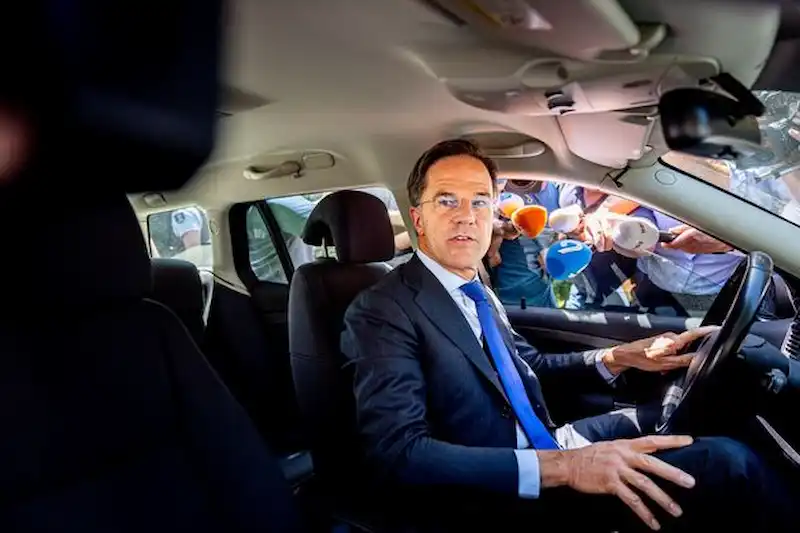


Dutch Prime Minister Mark Rutte has announced his resignation after his coalition government collapsed due to internal disagreements over migration policy, leaving the Netherlands in a state of uncertainty. Rutte, who has been in power for 13 years, addressed Dutch lawmakers in The Hague on Monday, stating that he will step down as the leader of his party, the VVD, and leave active politics after the upcoming elections.
Rutte's departure marks the end of a political career that saw him play a central role in European Union politics during challenging times such as the debt crisis, the COVID-19 pandemic, and the war in Ukraine. Known for his ability to shape the agenda and navigate complex alliances, Rutte was considered the glue between government leaders in the EU. His departure could create a vacuum in European politics and poses a challenge to the institutional memory of the group of heads of state.
The resignation of Rutte also signifies a changing of the guard in European politics, following the retirement of Germany's long-serving Chancellor Angela Merkel in 2021. With Rutte's departure, Hungarian Prime Minister Viktor Orban becomes the longest-standing premier in the European Union.
Not only does Rutte's resignation bring uncertainty to the Dutch political landscape, but it also raises questions about the future of the VVD, which may struggle to maintain its position as the country's largest party. Several potential contenders for the party leadership have been speculated, but it remains to be seen who will replace Rutte.
The collapse of Rutte's government occurred after he issued an ultimatum to limit the right to family reunions for refugees from war zones. The issue of immigration has been gaining prominence in the Netherlands, and Rutte staked his fourth coalition on his ability to enforce his stance. However, his former coalition partners turned against him, leading to the collapse of the government and the prospect of an undignified exit for Rutte.
Rutte's tenure as prime minister has been marked by various controversies and challenges. He faced a childcare subsidies scandal that triggered the collapse of his third cabinet and oversaw declining healthcare and education systems amid a labor shortage. Additionally, his government has grappled with issues such as high inflation, an energy crisis, and a lack of affordable housing.
Following his announcement to exit politics, Rutte appeared cheerful and engaged in conversations with party leaders in parliament. While he did not elaborate on his legacy, he expressed his gratitude to lawmakers and stated that he is not interested in pursuing top positions in multinational bodies. Instead, he may turn to teaching, a role he currently fulfills once a week at a school in The Hague.
In conclusion, Rutte's resignation signifies a significant change in Dutch and European politics, leaving the Netherlands in uncertainty and the European Union without his long-standing presence. The upcoming elections will shape the future political landscape, while Rutte prepares to leave active politics after 13 years at the helm.