


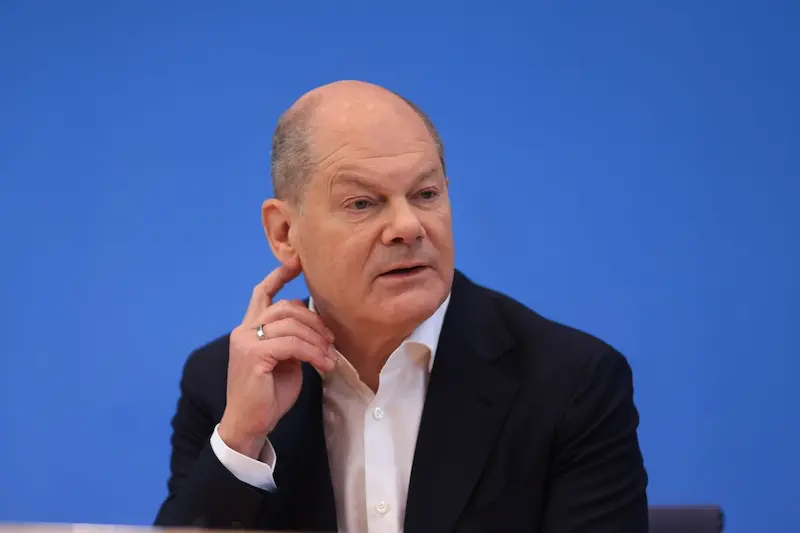


Chancellor Olaf Scholz is facing significant challenges as he tries to address the multiple issues that Germany is currently facing. With his coalition government dealing with internal squabbles, the threat of a recession looming, and the country's industrial base at risk, Scholz's leadership is being put to the test.
The sense of uncertainty has opened the door for a surge in support for far-right parties like the Alternative for Germany (AfD), which has become the second-most popular party in the country. This marks a shift from the political consensus that has supported Germany's prosperity since World War II. Scholz acknowledges the need to address this rise in extremism and has emphasized the importance of providing a vision for a positive future.
Recent events have highlighted the shifting security priorities of Germany. The deployment of German-made tanks to Ukraine and the movement of nuclear missiles closer to Belarus have underscored the need for a reevaluation of security strategies. Additionally, the rush to transition to renewable energy sources has become more urgent as Russia's gas flows to Germany are disrupted. Furthermore, China's push for electric vehicles poses a threat to Germany's car industry, which is a crucial driver of the country's economy.
These challenges are placing immense pressure on Chancellor Scholz, whose limited charisma is not helping his cause. In response, Scholz has adopted an awkwardly cheery tone, attempting to offer hope and reassurance to the German public. He acknowledges the concerns of citizens who are uncertain about the future and believes in implementing policies that provide people with reasons to believe in a better future.
The rise of the AfD can partly be attributed to the dissatisfaction with Scholz's leadership, as well as the failure of the Christian Democrat Union to capitalize on this discontent. Although the AfD's support is still relatively low compared to countries like France and Italy, Germany's history with extremism demands attention to this growing party. Scholz understands that a perception of decline is contributing to the surge in far-right support, as people are more likely to vote for extreme parties when they do not see a promising future for themselves.
Despite the challenges he faces, Scholz remains determined to counter the rise of the AfD. He draws inspiration from the American philosopher Richard Rorty and his belief in the importance of providing a narrative that everything can get better. Scholz's government points to recent policy decisions, such as Intel's investment in Saxony, as evidence of their success in generating economic opportunities and addressing the concerns of voters.
However, Scholz's flagship project of transitioning Germany to a carbon-neutral future has faced criticism. The recent initiative to ban new fossil-fuel boiler systems was met with backlash, further highlighting the discontent among citizens about the government's handling of major national challenges. The AfD has capitalized on these concerns by questioning the impact of human activities on global warming and advocating for stricter immigration policies.
The Chancellor's optimistic response often relies on hope rather than concrete expectations. He has previously made overly optimistic statements regarding Germany's economic outlook which turned out to be incorrect. Additionally, coalition infighting and the rise of the AfD are further evidence for Scholz that Germans have lost the ability to compromise.
Ultimately, Scholz believes that confronting the challenges posed by China's economic dominance could offer a more active response and an opportunity to reassert Germany's position in the global economy. He remains confident that the AfD's surge in popularity will not be sustained, focusing on countering their narrative and referring to them as the "bad mood party."
In summary, Chancellor Scholz is facing numerous challenges as he tries to address Germany's current issues. The rise of the far-right AfD, internal coalition disputes, and the changing security and economic landscape are testing his leadership. However, Scholz remains determined to confront these challenges and provide a vision for a better future for Germany.