


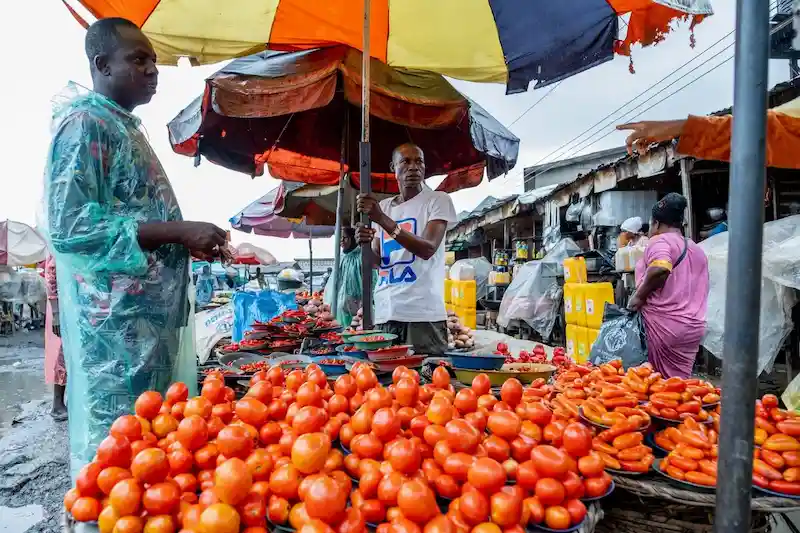


Nigeria is currently grappling with its highest monthly inflation rate in over seven years, primarily driven by soaring food costs. In June, prices surged by 2.1%, marking the largest increase since May 2016. The annual inflation rate also quickened to 22.8% compared to May's 22.4%. Although this figure falls slightly short of the 23% estimated by economists, the upward trend in both monthly and annual inflation is primarily attributed to the rising prices of food items. Annual food inflation rose to 25.3% in June and the monthly figure increased to 2.4%.
President Bola Tinubu, who assumed office in May, played a significant role in these inflationary pressures by eliminating fuel subsidies, weakening the currency, and subsequently declaring a state of emergency to address the rising costs of staple foods. The removal of fuel subsidies that were in place since the 1970s led to a nearly threefold increase in pump prices, while the relaxation of foreign exchange controls resulted in higher transport and import costs. As a result, the Nigerian currency depreciated by about 40% against the dollar in the past month.
In response to the escalating food costs, President Tinubu announced a state of emergency that permits the government to implement measures to enhance food security and supply. These steps include providing low-cost funding to farmers for the purchase of fertilizers, seedlings, and other agricultural inputs. Additionally, the government approved 500 billion naira in spending to mitigate the impact of the removal of gasoline subsidies.
Given the acceleration in both monthly and annual inflation, and the anticipation that price pressures will persist, it is likely that the central bank's monetary policy committee will opt to raise interest rates later this month. The committee has already boosted rates by 700 basis points since May 2022, bringing them to 18.5%, in an effort to combat inflation that has consistently exceeded its target range of 6% to 9% for over a year.
Economists predict that inflationary pressures will continue to mount due to the combination of subsidy removal and the weakened exchange rate. Bismarck Rewane, CEO of Financial Derivatives Co., believes that the July data will reflect these effects, with inflation rates projected to reach 25% or even 26%. Such expectations further strengthen the case for an interest rate hike.
The monetary policy committee is scheduled to meet on July 24-25, presided over by acting governor Folashodun Shonubi. Given the ongoing foreign currency and fiscal reforms and the persistently high inflation expectations, economists, like Mosope Arubayi from IC Group, anticipate another 50 basis point increase in interest rates at the upcoming meeting.