


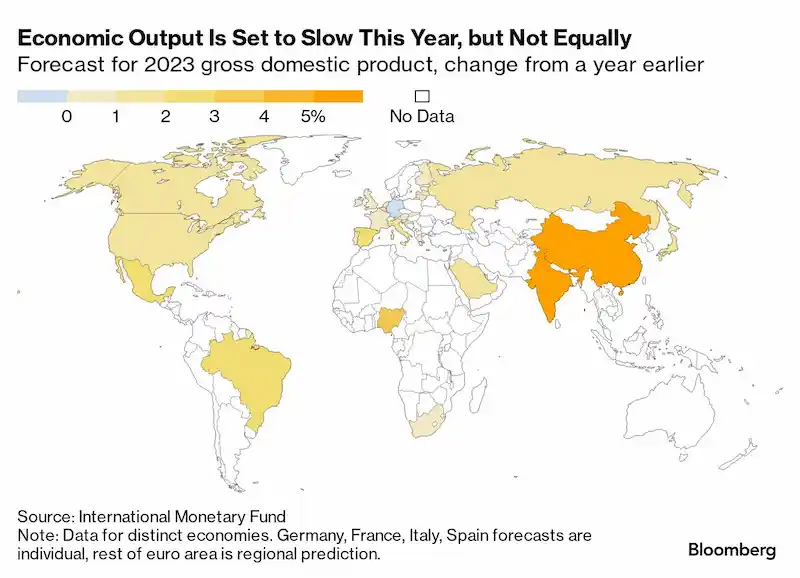


The International Monetary Fund (IMF) has revised its outlook for the global economy, citing a reduction in risks following successful resolutions of key financial issues. In its World Economic Outlook update, the IMF raised its projection for global gross domestic product (GDP) growth to 3% in 2023, up from the 2.8% forecast in April. Although this represents a slowdown compared to the 3.5% growth achieved last year, it suggests an improved economic outlook.
The IMF noted that the recent resolution of the US debt ceiling standoff and effective measures taken by authorities in the US and Switzerland to stabilize their banking sectors have played a crucial role in moderating adverse risks to the global economy. The IMF’s more positive outlook aligns with an increasing number of experts who are cautiously optimistic about a potential soft landing for the US economy.
However, the IMF also highlighted that global growth prospects remain weak compared to the pre-pandemic period, with an average growth rate of 3.8% during the two decades prior to Covid-19. The IMF emphasized that higher interest rates, implemented to curb inflation, could weigh on economic activity. Additionally, it warned that unforeseen events such as an escalation of the conflict in Ukraine or climate disasters could prompt further tightening by central banks, impacting global growth.
IMF Chief Economist Pierre-Olivier Gourinchas identified inflation as the biggest threat to the global economy. Despite some resilience in the global economic performance, Gourinchas stated that momentum is slowing down due to tighter monetary policies adopted to address inflationary pressures.
The IMF also identified several ongoing risks to global financial stability, including higher interest rates, a slower-than-expected recovery in China, debt distress in emerging economies, and threats to trade resulting from geoeconomic fragmentation. Recent events, such as Russia's invasion of Ukraine and tensions between the US and China, have contributed to the acceleration of geoeconomic fragmentation.
According to Bloomberg Economics, global growth is expected to reach 2.8% in 2023 and 2.7% in 2024, slightly below the pre-pandemic trend of 3.4%. The IMF stressed that central banks should prioritize restoring price stability, strengthening financial supervision, and actively monitoring risks. Both the US Federal Reserve and the European Central Bank are expected to raise interest rates further this week as they aim to curb inflation, with Fed Chair Jerome Powell and ECB President Christine Lagarde highlighting the persistently high rate of inflation.
Among the largest economies, the IMF revised its growth forecast for the US to 1.8% this year, a 0.2 percentage-point increase from April, with a slight decline to 1% expected in 2024. The IMF remains cautiously optimistic about the possibility of a US recession, stating that it is not part of their baseline forecast.
China's growth projection for this year remains unchanged at 5.2%, but the IMF warned that the nation's recovery is slowing due to various factors, including weakness in the real estate industry impacting investment, weak foreign demand, and rising youth unemployment.
The IMF also revised its forecasts for other countries, including an upward revision for the UK to a 0.4% expansion, reflecting better-than-expected consumption and a resilient financial sector. Russia's forecast was raised to 1.5% growth, driven by strong retail trade, construction, and industrial production. Brazil saw a significant upgrade to a 2.1% expansion following a surge in agricultural output, which also boosted activity in the services sector. Germany, on the other hand, is projected to contract by 0.3% due to weak manufacturing output and an economic contraction in the first quarter. Saudi Arabia's forecast was lowered to 1.9% to reflect oil-output cuts announced earlier this year.
While the IMF's raised global growth projections indicate a slightly more positive outlook, the organization remains cautious, noting that risks to global growth persist. Higher interest rates, geopolitical tensions, and various economic challenges could still pose threats to the fragile recovery.