


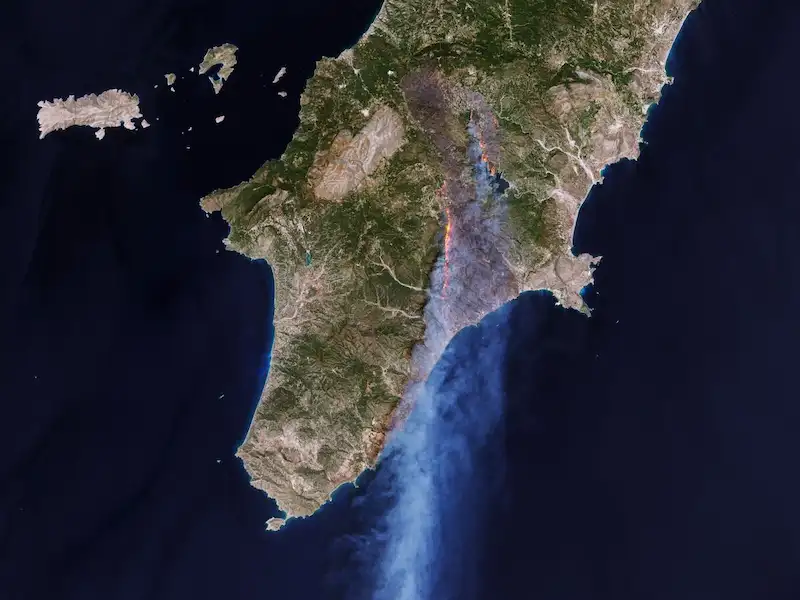


The focus of Europe's scorching heatwave has now shifted back to Greece, where wildfires have been reignited, prompting concerns for the safety of residents and intensifying firefighting efforts. With temperatures expected to soar to a staggering 48C (118.4F) by Wednesday, more than 100 wildfires are currently being battled by firefighters across Greece. The situation has already led to the evacuation of several villages on the islands of Corfu and Rhodes.
Adding to the complexity of the situation, a tragic incident occurred when a Greek fire department plane crashed shortly after dropping water on a fire on the island of Evia, east of Athens. This unfortunate event serves as a reminder of the dangerous conditions that firefighters are facing in their efforts to control the spreading blazes.
Unfortunately, the relentless heat and strong winds are complicating firefighting operations not just in Greece but across a vast stretch of the Mediterranean, spanning from Algeria to Turkey. This region has already experienced the hottest June on record, and the trend has continued into July with record-breaking temperatures. The extreme weather has wreaked havoc across southern Europe, unleashing devastating hailstorms, tornadoes, heavy rainfall, and powerful winds that have resulted in casualties in parts of the western Balkans.
Experts attribute the intensity of these heatwaves to global warming fueled by fossil fuel emissions. Scientists assert that such extreme heat would have been "virtually impossible" without the influence of climate change. Yet, despite mounting evidence and the urgency of the situation, many leaders are reluctant to accelerate efforts to reduce greenhouse gas emissions.
In Italy, the relentless heat shows no signs of abating, even though a slight cooling is predicted in the coming days. Just recently, Sardinia experienced a scorching temperature of 48C, inching close to the European record of 48.8C set in Sicily two years ago. The Italian landscape has also been battered by violent storms, featuring destructive hail that has further compounded the challenges faced by authorities.
Italian Prime Minister Giorgia Meloni acknowledged the multifaceted emergencies that the country is grappling with and stressed the dedication of firefighters and emergency services in securing the territory. The situation in Italy is emblematic of the new reality that multiple crises can occur simultaneously, putting immense strain on resources and personnel.
As the heatwave persists, Greece finds itself at the forefront of the battle against wildfires. Prime Minister Kyriakos Mitsotakis acknowledged the impact of the climate crisis and the challenges that lie ahead, including higher temperatures, increased droughts, and stronger winds. The Greek government has already issued evacuation orders for several areas, and a maximum wildfire alert has been declared for the island of Crete.
Across the Mediterranean, North Africa is also grappling with the repercussions of the heatwave. In Algeria, wildfires have claimed the lives of over 30 people, with coastal cities experiencing temperatures as high as 49C. Algerian authorities have detained two individuals on suspicion of arson. Similarly, Tunisia and Algeria are bracing for scorching temperatures on Tuesday, exacerbated by sirocco winds blowing off the Sahara.
Not only are the countries around the Mediterranean feeling the heat, but the sea itself is warming at an alarming rate. On Monday, average sea temperatures reached a record 28.4C, with some areas registering as high as 32.5C. This not only poses a threat to marine life but also increases the risk of invasive species proliferating.
In a stark contrast, Northern Europe is experiencing much milder conditions as a cooler weather system sweeps in. Temperatures in the UK, Germany, France, and Nordic countries are expected to be below seasonal averages. This respite from the scorching heat provides some relief to these regions, while the focus shifts to the ongoing challenges faced by countries in the Mediterranean.