


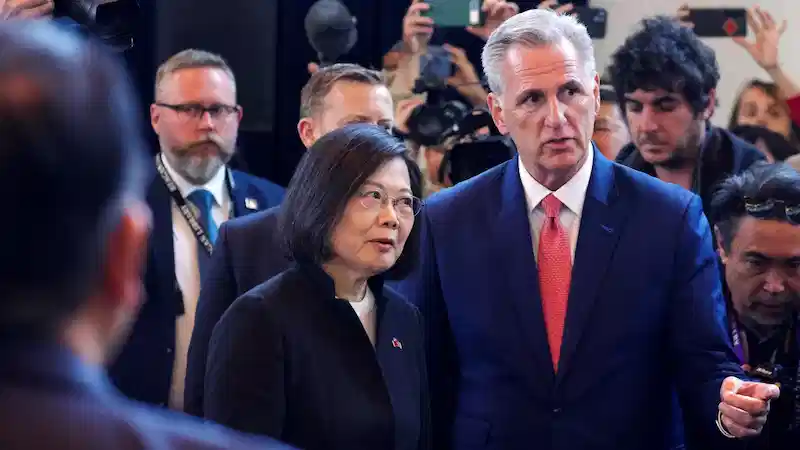


On Friday, China's Ministry of Foreign Affairs declared that the Hudson Institute, a Washington-based think tank, and the Ronald Reagan Presidential Library in California would face sanctions prohibiting any collaboration, exchange or dealings with organizations and individuals in China. The ministry also announced that key leaders of the organizations would be prevented from visiting China, transacting or cooperating with anyone in the country, and their assets in China would be frozen. The reason given was that the Hudson Institute and the Reagan Library had enabled Taiwan President Tsai Ing-wen's separatist activities, which were seen as a severe threat to China's sovereignty and territorial integrity. The sanctions were imposed after Tsai's meetings with US House Speaker Kevin McCarthy at the Ronald Reagan Presidential Library last Wednesday and her receipt of the Global Leadership Award from the Hudson Institute in New York City last week, both of which occurred during her 10-day international tour that included official visits to Central America.
Following Taiwan President Tsai Ing-wen's meeting with US House Speaker Kevin McCarthy, China had warned of taking firm and robust measures in response. Despite never having controlled Taiwan, China claims the self-governing democracy as its own and has promised to take it by force if necessary. On Friday, China imposed sanctions on the Hudson Institute, Ronald Reagan Presidential Library, and two Taiwanese organizations, The Prospect Foundation and Council of Asian Liberals and Democrats, for promoting Taiwan independence and being unable to collaborate with mainland organizations or individuals. Hsiao Bi-khim, Taiwan representative to the US, was also sanctioned for the second time by China, following a visit from then-US House Speaker Nancy Pelosi to the island last year. Taiwan's foreign ministry has since responded, calling China's decision to impose new sanctions "irrational and absurd," asserting Taiwan's "fundamental right" to conduct diplomatic activities overseas, and that Beijing's "coercion and suppression" would only strengthen its "insistence on freedom and democracy."
China's response to the recent meeting between Taiwan President Tsai Ing-wen and US House Speaker Kevin McCarthy appears to be less severe than its reaction following the visit of then-US House Speaker Nancy Pelosi to the island last year. After Pelosi's visit, Beijing conducted extensive military drills around Taiwan and suspended several communication lines with Washington. However, this time, there has been little military response from China, which frequently conducts patrols in the surrounding waters and incursions into Taiwan's air defense identification zone. Taiwan's Defense Ministry reported that a Chinese aircraft carrier group had passed through waters southeast of Taiwan for training in the Western Pacific ahead of the Tsai-McCarthy meeting. The latest move from China comes amid increasing tension in its relationship with the US, which has provided support to Taiwan against Beijing's military, economic, and diplomatic pressure. Although the US acknowledges China's position that Taiwan is a part of China, it has never officially recognized Beijing's claim to the island, and Tsai's transit in the country was unofficial to maintain Washington's "One China" policy. Tsai is expected to return to Taiwan on Friday.