


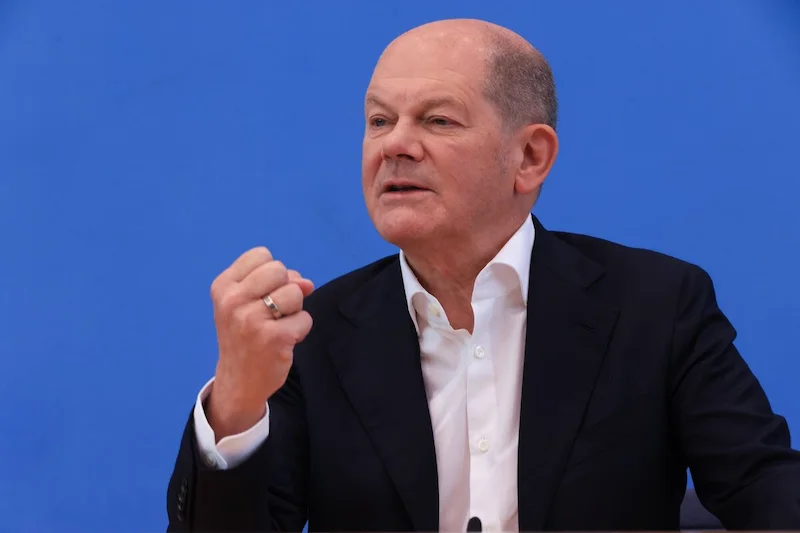


German Chancellor Olaf Scholz is optimistic that investments in green technology will play a crucial role in reviving the country's economy. In an interview with public broadcaster ZDF, Scholz stated that spending on renewable energy sources, hydrogen production, and associated networks will have a significant impact on the entire economy. Recognizing the need for immediate action, Germany has already revised its legislation to expedite the construction of infrastructure to meet the country's green energy requirements.
Germany's economy has been facing challenges, with stagnation observed during the second quarter due to a winter recession, soaring energy costs, a shortage of skilled labor, and rising interest rates in the euro-zone. The decline in industrial output, particularly in the automotive and construction sectors, further underscores the need for measures to jumpstart economic growth.
As a response to these difficulties, there have been calls for the government to extend a cap on power and gas prices for both companies and households. However, in parallel, the German government is also focusing on attracting investments in high-tech industries. To this end, it has offered multi-billion euro subsidies to entice chipmakers. In a significant development, Taiwan Semiconductor Manufacturing Co. recently agreed to establish a €10 billion plant in eastern Germany, in partnership with Infineon Technologies, NXP Semiconductors, and Robert Bosch.
This success follows the government's earlier agreement to provide €10 billion in aid for a new Intel Corp. plant in Magdeburg. These foreign investments not only bolster the country's economic prospects but also provide a vote of confidence in Germany as an attractive location for businesses. Scholz emphasizes that the companies' decisions to invest were not solely driven by subsidies but were rather a reflection of Germany's appeal as an economic hub.
However, despite the positive developments, Scholz and his coalition government, comprising the Social Democratic Party (SPD), the Greens, and the liberal Free Democratic Party (FDP), face challenges on the political front. Polls indicate that the coalition is currently not favored by the majority of voters. Only 21% of respondents in a recent ZDF survey expressed confidence in Scholz's ability to implement his political agenda.
Nonetheless, Scholz remains committed to promoting green technology investments as a means to revitalize Germany's economy. By focusing on sustainable and innovative industries, he aims to steer the country towards a path of economic recovery and growth.