


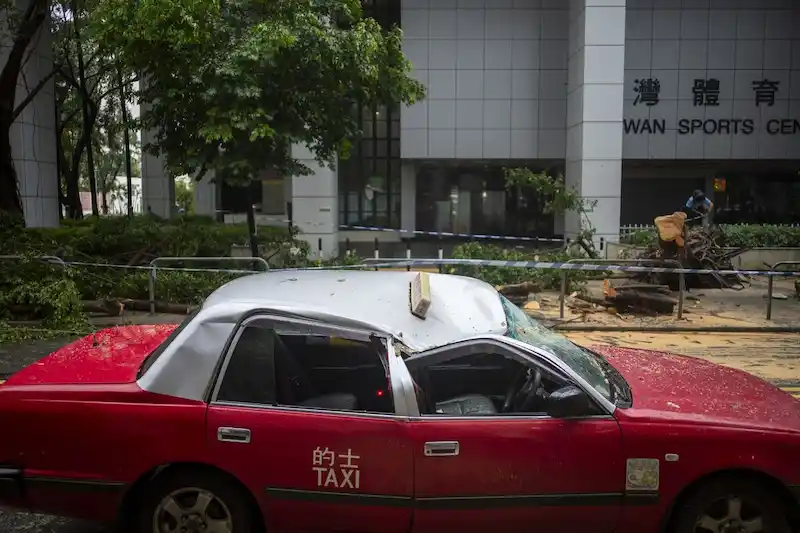


Hong Kong has begun to recover after Typhoon Saola, which was predicted to be the strongest typhoon to hit the city in five years, swept through the territory. The airport, businesses, and public transportation started resuming operations gradually, while street cleaners worked diligently to clear debris and uprooted trees left in Saola's wake. The Hong Kong Observatory downgraded its storm warning from No. 8 to No. 3, but this signal will remain in effect until the threat diminishes further.
Saola brought powerful gales and caused flooding in at least 18 areas of the city. A total of 75 people sought medical treatment at public hospitals. The typhoon, with sustained winds of 210 km/h near its center, was equivalent in strength to a Category 4 hurricane on the Saffir-Simpson scale. In response, the Home Affairs Department opened 40 temporary shelters where 511 people sought refuge. The Labour Department also reminded employers to make practical work arrangements, including work from home, to ensure the safety of their employees.
The Airport Authority reported that about 480 flights were operational on Saturday, a significant decrease from the originally scheduled 850 flights for Friday. Cathay Pacific Airways Ltd., the largest airline in Hong Kong, aimed to recover quickly from the disruption and had its first departure to Sydney scheduled for 11 a.m., slightly earlier than planned. The stock market remained closed on Friday, and school suspensions were extended through Saturday. Most public transportation was halted as well. The requirement for the Hong Kong stock exchange to halt trading when Signal No. 8 or above is raised is being questioned, as global financial industries have adapted to remote working during the pandemic. Calls have been made to explore arrangements that would allow continuous trading even in bad weather.
This storm, the strongest since the 2018 typhoon Mangkhut, was seen as a significant test for Chief Executive John Lee's government. Criticisms were raised after the last major typhoon, as roads in Hong Kong remained blocked for several days due to fallen trees, causing difficulties for people trying to commute to work. Over the past four decades, only five storms have led to the raising of the highest signal in Hong Kong.
China's national weather authorities also issued their highest alert for Typhoon Saola, warning of severe weather in the coastal provinces of Fujian and Guangdong. Local officials were urged to be prepared for flash flooding. In Macau, the world's largest gambling hub, casinos reopened following a rare shutdown prompted by the typhoon. The storm warning level was lowered from No. 10 to No. 8.
Meanwhile, Taiwan and eastern China are bracing for another storm as Typhoon Haikui approaches. Taipei has issued a land warning, and the Central Weather Bureau reported that the typhoon, with sustained winds of up to 137 km/h and gusts reaching 173 km/h, was approximately 520 kilometers (323 miles) away from Taiwan's southernmost point as of Saturday morning.