


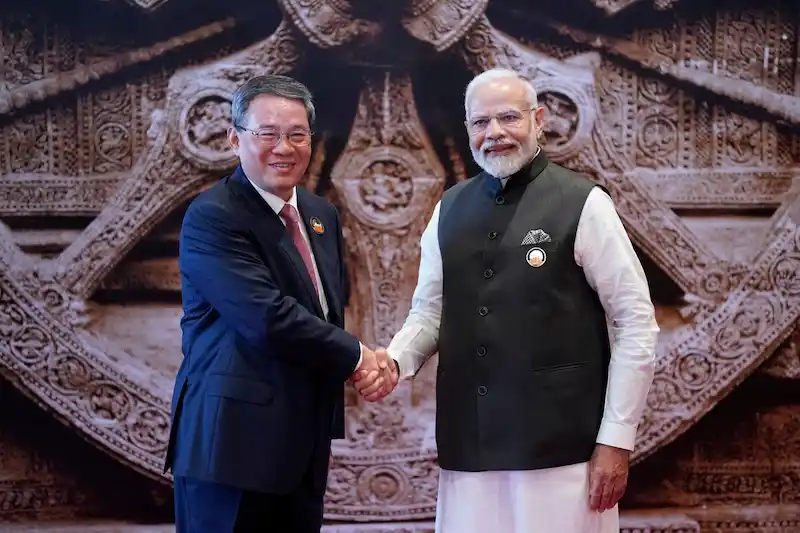


Indian Prime Minister Narendra Modi, along with the United States and Europe, successfully countered China on the world stage at the recent Group of 20 (G-20) summit. While Chinese President Xi Jinping's decision to skip the summit denied India its anticipated moment, the G-20 nations hailed India’s success in reaching agreement on a joint communique. The communique addressed the difficult issue of Russia’s war in Ukraine, elevated the African Union as a full G-20 member, and took action on priorities of emerging markets such as climate change and debt sustainability.
President Joe Biden recognized India as a key player in isolating China and Russia, and viewed it as a means to boost the US-led world order. This summit showcased that the US is learning to engage with the so-called Global South, with India as its principal guide. The US actively supported India's achievements at the summit, demonstrating its commitment to empowering India as a rising power capable of countering China's global influence.
During the summit, President Biden met with key members of the BRICS grouping - India, Brazil, and South Africa - while excluding China and Russia. This bloc expansion posed a challenge for the Group of Seven advanced economies. Additionally, the US announced a deal with India, the European Union, Saudi Arabia, Israel, and other Middle Eastern countries to develop a rail and maritime network in the region. This move aimed to provide competition for China's Belt and Road Initiative and enhance Middle East interests.
China's refusal to attend the G-20 summit, along with its attempts to obstruct India's progress, ultimately backfired. Although criticisms emerged regarding a compromise on the war language in relation to Ukraine, supporting the compromise provided the US with an opportunity to align more closely with major democracies in the Global South. By bolstering India and amplifying other democracies, the US aims to counter China and Russia's influence, particularly in resolving the conflict in Ukraine.
The agreement reached at the G-20 not only saved the summit as the last global forum bringing together major powers but also bridged the gap between the G-7 and emerging markets. It allowed emerging markets to partner with the G-7 in holding Russia accountable if it fails to seek a just peace according to UN principles. Moreover, China's absence from the summit further solidified India's leadership in the Global South, providing the US and Europe a clear path to strengthen ties with emerging markets.
India successfully seized the moment to assert its global leadership role at the G-20 summit. Prime Minister Modi declared the outcome as historic, and India's chief negotiator emphasized India's position as the spokesperson for the Global South. The summit not only amplified the voice of the Global South but also showcased India's ability to bring the world together on developmental and geopolitical issues.
Despite this success, the US must remain cautious in its approach to the Global South. President Biden's decision to skip a summit hosted by the Association of Southeast Asian Nations was seen as a snub and required damage control. However, the G-20 summit highlighted India's capacity to lead and brought to the forefront its role in countering China's growing influence.