


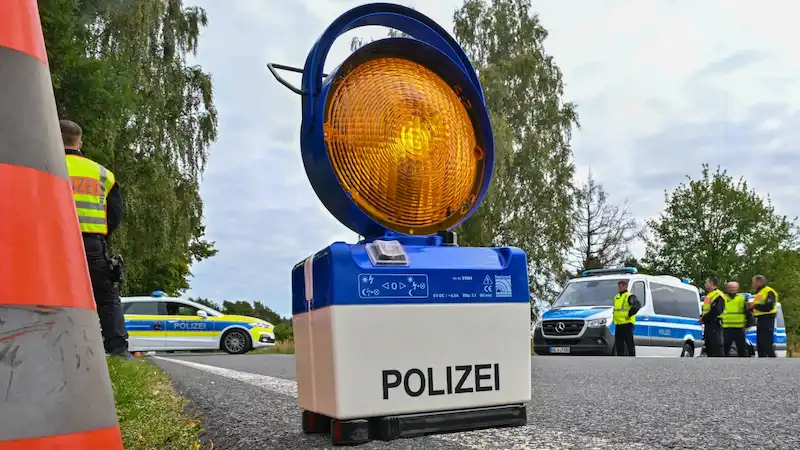


Germany has announced that it will be intensifying its border controls with Poland and the Czech Republic in order to combat human trafficking. The move comes as the country finds itself embroiled in a heated debate over its migration policy, particularly as the number of asylum applications continues to rise. The Interior Minister, Nancy Faeser, stated that the police will be conducting additional flexible checks and mobile controls along the smuggling routes at the borders with Poland and the Czech Republic. This measure will be implemented immediately with the support of the respective authorities from both countries. The main objective behind these intensified controls is to put an end to the cruel business of smugglers, who endanger human lives for maximum profit.
This announcement follows the interior minister's suggestion to potentially implement fixed controls along the borders with these neighboring countries. Although such measures would be temporary and exceptional under the rules of the Schengen Area, it highlights the seriousness with which Germany is approaching the issue of immigration.
Currently, the state of Bavaria, which shares a border with Austria, is the only region in Germany with stationary border controls. These controls were established during the 2015-2016 migration crisis when Germany took in over a million refugees, making it Europe's leading economy in terms of refugee intake.
Immigration has become a contentious topic once again in German politics, especially with regional elections in Bavaria and Hesse approaching. These elections will be a significant test for Chancellor Olaf Scholz's center-left coalition.
The German Office for Migration and Refugees has reported a significant increase in asylum applications, with over 204,000 applications registered between August and January 2023. This represents a 77 percent increase compared to the same period last year. The influx of refugees from the war in Ukraine, estimated to be around one million, further adds to the strain on local governments and municipalities.
The German Federal Police also noted a nearly 60 percent increase in illegal entries into the country during the same period. This surge has overwhelmed many local communities, leading to concerns about capacity and resources. Alexander Handschuh, spokesperson for the German Association of Towns and Municipalities, stressed the need for a coordinated solution and highlighted the strain placed on public facilities, such as gymnasiums being used as makeshift housing for migrants.
In response to the crisis, Berlin's center-left coalition government has taken steps to address the issue. However, there are calls for greater responsibility and cooperation from countries on Europe's borders, including Italy, to protect their borders and adhere to the procedures set out by the European Union.
As Europe faces an escalating migration crisis, Germany's decision to ramp up border controls reflects the ongoing challenges and debates surrounding immigration policy. The question remains whether Germany, as well as the broader European Union, can effectively manage the influx while upholding the principles of Schengen and ensuring the safety and well-being of all individuals involved.