


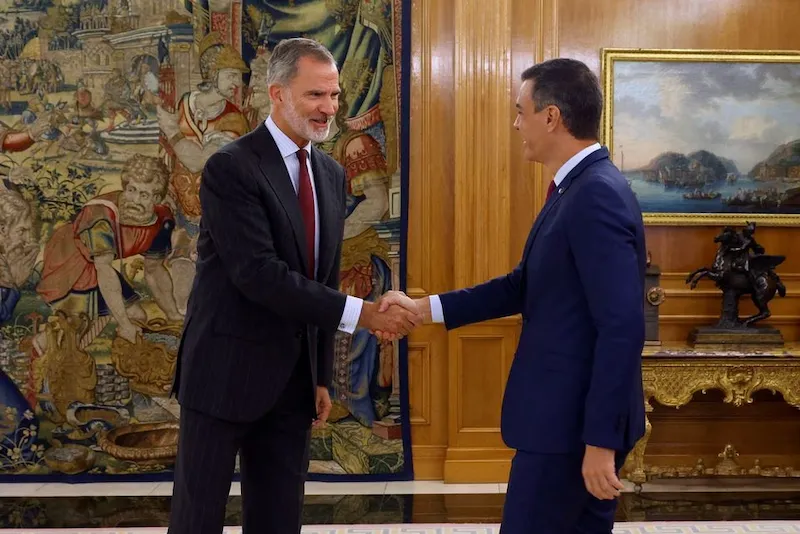


Spain's acting Prime Minister, Pedro Sanchez, is bracing himself for what he predicts will be complex and challenging negotiations with other political parties as he seeks their support to form a new government. Sanchez, leader of the Socialist party, not only aims to secure a government but also to pass legislation as a minority coalition during his second four-year term. The Socialists won fewer seats than the conservatives in the inconclusive election held on July 23, making it necessary for Sanchez to seek support from potential coalition partners such as the hard-left Sumar and several Catalan and Basque nationalist parties.
To win an investiture vote, Sanchez needs to rally support from these parties. However, if no candidate secures a majority by November 27, Spain will have to hold a repeat general election. Sanchez expressed his willingness to work towards forming a progressive coalition government that has enough support to ensure the stability the country needs.
Sanchez was invited to try to form a governing majority after the conservative candidate Alberto Nunez Feijoo failed in his bid to become prime minister. Sanchez believes he can gather enough backing for his candidacy, including the support of Catalan separatist parties Junts and ERC. These parties, however, have demanded an amnesty in exchange for their votes, although Sanchez avoided explicitly mentioning this during a press conference in Madrid.
Sanchez defended his decision to pardon Catalan leaders jailed over a failed independence bid in 2017, describing it as a success. He stated that the crisis caused by the independence bid brought no good, and since then, he has been attempting to overcome the situation. Sanchez emphasized the importance of resolving political conflicts through politics and emphasized the need for "politics, generosity, and leadership."
Junts and ERC recently passed a resolution stating that they would not support an investiture vote unless the government committed to creating conditions for a fresh referendum on Catalan independence. When asked about a referendum, Sanchez expressed that Catalans are looking to move forward and reunite with Spanish society.
Feijoo, Sanchez's opponent, criticized him for considering an amnesty during his investiture bid. Feijoo believes Sanchez is acting in accordance with the desires of Junts leader Carles Puigdemont and predicted difficult negotiations in the coming weeks.
Sanchez expressed his desire to conclude the talks and set a date for a vote as soon as possible. He intends to begin talks with the main parties, starting with the head of Sumar, his Labour Minister Yolanda Diaz. Sanchez acknowledged that the negotiations ahead would not be easy but stated that he is committed to putting in the necessary effort.
House Speaker Francina Armengol mentioned earlier that Sanchez has yet to share his proposed schedule for the investiture vote. As the negotiations unfold, Spain eagerly awaits the formation of a new government that can address the pressing issues facing the nation.