


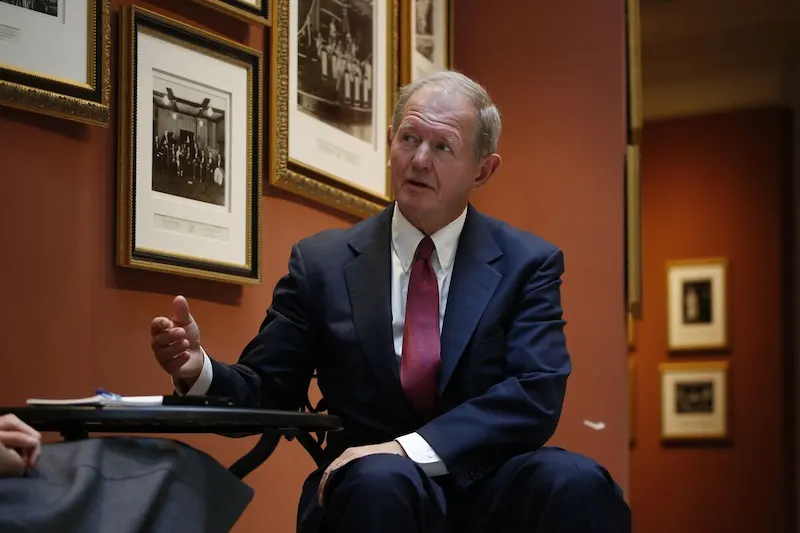


As tensions between China and the US continue to shape global dynamics, Marcus Wallenberg, a prominent Swedish business leader, emphasized the need for companies and governments to adapt to a "completely new world order." In an interview with Bloomberg, Wallenberg highlighted the necessity of investing billions of public dollars in clean-energy industries, driven by the growing competition in this sector between the western countries and China.
While Wallenberg considers himself a proponent of free trade, he acknowledged that the current geopolitical circumstances have compelled everyone to recognize the importance of investing in future-oriented sectors. He stressed that the transition to a green economy would require substantial financial resources, whether directed towards research and development or financing large-scale infrastructure projects. In his view, this transition cannot be achieved by a single party alone; instead, it necessitates cooperation between businesses and governments. The specific mechanisms for such collaboration can be debated, but Wallenberg emphasized that it will be a prerequisite for success.
Recently, Wallenberg led a Swedish business delegation to meet with Canadian Prime Minister Justin Trudeau in Ottawa. The delegation included representatives from various sectors such as investment, manufacturing, telecommunications, and more. Trudeau, a proponent of the US-led effort to challenge China's dominance in clean energy, has pledged up to $5 billion in public money to support Sweden's Northvolt AB in building a battery plant in Quebec.
The Covid-19 pandemic has exposed the vulnerabilities of relying solely on global supply chains, according to Wallenberg. He also highlighted the impact of President Joe Biden's Inflation Reduction Act, which includes substantial subsidies for green manufacturing. This has prompted allied countries like Canada to match those funds or risk losing out on crucial investments from global companies.
Wallenberg acknowledged China's significant progress in the battery and electric vehicle (EV) industries, pointing to the competitive prices and quality of their latest EV models. He emphasized the need for other countries to learn from China's achievements and enhance their competitiveness.
In addition to Canada's efforts, Wallenberg expressed his belief that Europe is also gradually adopting an industrial policy to support its clean energy transition. However, he noted the ongoing debate surrounding the use of subsidies to bolster industry. Wallenberg highlighted the successful projects launched in Sweden due to favorable local conditions and innovation, emphasizing the various ways in which industry can be supported.
Regarding business ties between Sweden and Canada, Wallenberg stated that there is great potential for further strengthening these relationships. He praised Canada as a high-tech country with skilled labor and companies that can contribute significantly to the clean energy sector. He also commended Canada's progress in transitioning to a more sustainable economy, expressing optimism about the country's direction.
Marcus Wallenberg, as the chair of FAM AB and Patricia Industries, is involved in various sectors such as banking and finance, defense, private equity, and pharmaceuticals. The Wallenberg family has a long-standing business legacy, starting with the founding of SEB AB (formerly known as Skandinaviska Enskilda Banken) in 1856. He expressed his family's belief in the opportunities presented by the clean-energy shift, stating that it would offer a competitive advantage in the future. While some may not currently see the full potential of green business, Wallenberg is confident that its advantages will become evident in the years to come.