


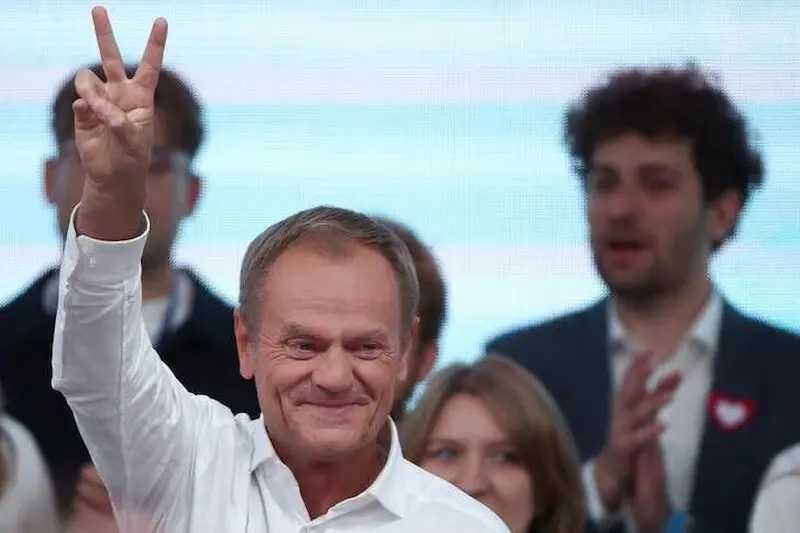


Donald Tusk, leader of the Civic Coalition (KO), has called on Poland's president to swiftly allow the formation of a new government following the official election results. The results showed that Tusk's liberal pro-EU party and its allies have won a majority, marking a significant shift in Poland after years of conflict between the ruling nationalist Law and Justice (PiS) party and the European Union. Tusk is appealing to the president for quick decisions in order to address the urgent needs of the people.
The Electoral Commission confirmed that PiS had lost its majority, although it remains the largest single party in the lower house of parliament. PiS secured 35.38% of the vote, earning 194 seats in the 460-seat chamber. Tusk's KO won 30.70% of the vote, followed by the centre-right Third Way with 14.40%, the New Left with 8.61%, and the far-right Confederation with 7.16%.
The combined seats of the KO, Third Way, and New Left amount to 248, granting them the ability to form a stable coalition government. Discussions regarding the shape of the future government are currently ongoing between the leaders of the three groupings.
However, the process of forming a government could potentially take several weeks or even months. President Andrzej Duda, an ally of PiS, had previously stated that he would give the first opportunity to form a cabinet to the group or party that won the most ballots. As no party has expressed willingness to join a PiS-led government, it is unlikely that the nationalist party will be able to secure a third term as the leading party in Poland.
In this scenario, President Duda is expected to invite Donald Tusk, leader of the second-largest party, to attempt to form a government. Marek Suski, a senior PiS official, acknowledged the likely transition to the opposition, stating, "Evil has prevailed in Poland, temporarily. PiS is likely moving into a really democratic opposition."
The election witnessed a historic turnout, exceeding 74%, the highest since the fall of communism in 1989. The parties managed to mobilize a significant number of young voters, reflecting an increased level of political engagement. However, the campaign was marred by divisive rhetoric, underscoring the deep polarization within Polish society.
PiS framed the vote as a battle to protect Polish borders and sovereignty, positioning it as a fight against the perceived threats of migration and interference from unelected EU bureaucrats. Opposition leaders, including Tusk, warned that PiS would lead Poland towards exiting the EU if they secured a third term, although PiS denies these claims despite their ongoing conflicts with Brussels.
While the opposition parties have not yet announced a candidate for the position of prime minister, Tusk is widely expected to be their nominee. Having previously served as Polish premier from 2007 to 2014, Tusk is recognized for his energy and determination in driving change in Poland.
However, the three parties forming the coalition are likely to face complex negotiations on controversial issues such as abortion and LGBT rights. Third Way, led by Wladyslaw Kosiniak-Kamysz, expressed support for reversing the 2021 near-total ban on abortions by reinstating the right to abortion in cases of fetal defects but held reservations about further liberalization. Meanwhile, KO and the New Left advocate for unrestricted abortion up to 12 weeks, while Third Way proposes that the matter be decided through a referendum.
Kosiniak-Kamysz stressed that no ideologically charged issues would be included in any coalition agreement. The negotiations, therefore, may prove challenging as the parties strive to find common ground and create a government that best represents the diverse interests of the Polish population.