


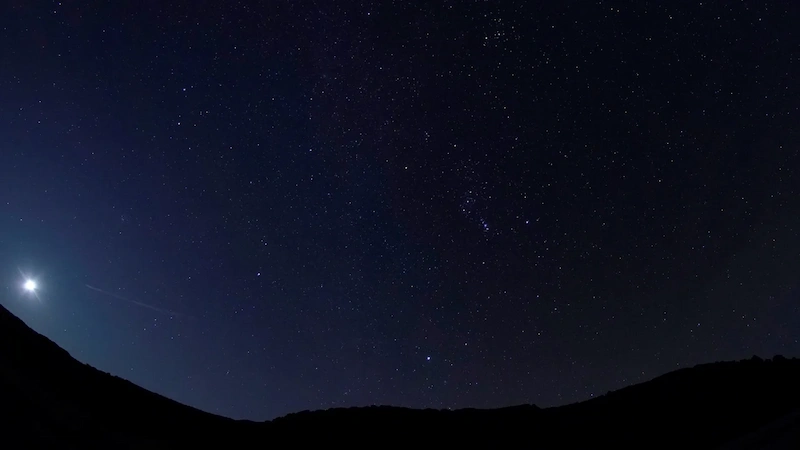


Get ready for a celestial spectacle this weekend as the Orionid meteor shower graces the night skies. From Saturday to Sunday, the shower will reach its peak, with an expected rate of 10 to 20 visible meteors streaking across the heavens per hour. Regardless of your location on Earth, you'll have the chance to witness this mesmerizing show throughout the night. The height of the shower will occur around 2 a.m., when the radiant point of the meteors, the constellation Orion, is at its zenith. However, meteors will start appearing as soon as dusk falls, so be on the lookout early on.
For the best viewing experience, try to observe the meteor shower in the early morning hours when the moon, currently in its first quarter phase, will set near midnight. Keep in mind that the moon's luminosity might slightly hinder meteor visibility. Dr. Ashley King, a planetary science researcher, advises waiting for the moon to set and recommends allowing your eyes to adjust to the low light for at least 10 to 20 minutes before stargazing. Find a spot away from light pollution with a clear view of the dark sky for optimal celestial viewing.
The Orionid meteor shower originates from the famous comet Halley, which orbits the sun every 76 years. Although Halley won't likely grace our night sky until 2061, it leaves behind a trail of debris that Earth passes through annually, resulting in the Orionids. In early May, Earth traverses a different part of Halley's orbital path, giving rise to another meteor shower known as the Eta Aquariids.
The Orionid meteors are known for their brightness and fast pace, hurtling through the atmosphere at an astonishing speed of 148,000 miles per hour. Their high velocity often leaves behind long trails in the sky, marking the release of dust as the meteors heat up during entry. While this year's rates are expected to be normal, there have been sporadic meteor rate spikes during past Orionid showers, reaching anywhere from 50 to 75 meteors per hour.
More than just a breathtaking visual display, meteor showers offer a glimpse into the early formation of our solar system. These dust grains originated over 4.6 billion years ago, making them remnants of the primordial days of our cosmic neighborhood.
Following the peak of the Orionids, the rate of visible meteors will gradually decline until the shower concludes on November 22. If you miss this weekend's event, don't worry! There are still five more meteor showers to catch before the year ends, including the Southern and Northern Taurids, Leonids, Geminids, and Ursids.
Looking beyond meteor showers, there are three full moons remaining in 2023. The upcoming full moons will be the Hunter's moon in October, the Beaver moon in November, and the Cold moon in December, according to the Farmers' Almanac.
Additionally, for eclipse enthusiasts, an annular solar eclipse took place on October 14, offering a mesmerizing "ring of fire" in the North, Central, and South American skies. Although the last solar eclipse event until 2024, a partial lunar eclipse is set to occur on October 28. Visible in Europe, Asia, Australia, parts of North America, and a significant portion of South Africa, this lunar eclipse will reveal the moon dipping into Earth's shadow, creating a captivating spectacle.
So, mark your calendar and set your gaze towards the skies for the Orionid meteor shower this weekend. Prepare to be amazed by the cosmic wonders unfolding above as you witness the remnants of Halley's comet illuminating the night.