


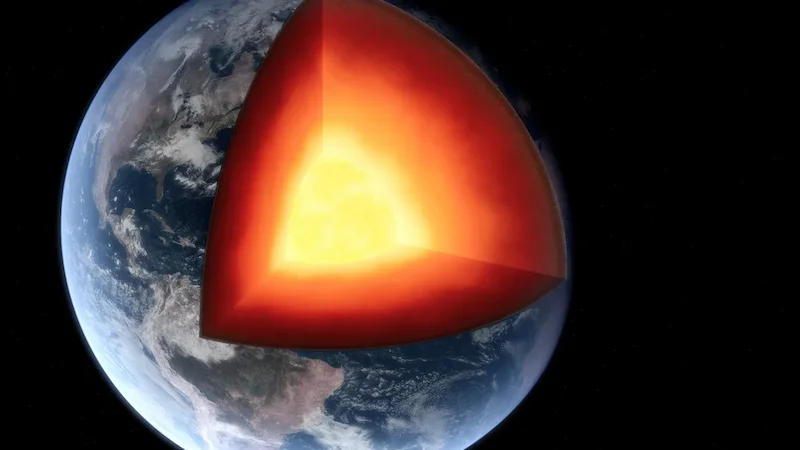


Scientists have made a surprising discovery on Canada's Baffin Island, where they detected a significant amount of helium-3, a rare version of the noble gas, in volcanic rocks. This finding provides support for the theory that helium-3 has been leaking from Earth's core for thousands of years. The research team also found helium-4 within the rocks, which is more commonly found on Earth. This unexpected abundance of helium-3 challenges previous assumptions about the presence of this element on our planet. The study detailing this discovery was recently published in the journal Nature.
Helium-3 is scarce in our universe compared to helium-4. According to lead study author Forrest Horton, this rarity is due to the fact that helium-3 has not been produced or added to Earth in substantial quantities and is lost to space. As the Earth's rocky portion moves and convects, material rises, cools, and then sinks. During the cooling process, helium is lost to the atmosphere and eventually escapes into space.
Detecting elements that leak from Earth's core is crucial in understanding the formation and evolution of our planet. The new findings strongly support the existing hypothesis that Earth originated within a solar nebula, a cloud of gas and dust that likely collapsed due to a nearby supernova explosion. This nebula is believed to have contained helium-3, and the trace amounts leaking from Earth's core confirm this theory.
To investigate the contents locked within Earth's core and mantle, the research team conducted their study on the ancient lava that erupted millions of years ago during the separation of Greenland and North America. Baffin Island provided the ideal location for their research, with its unique landscape of volcanic cliffs, icebergs, and polar bears on the coastline. The team collected samples from the island's rocks, and their measurements revealed higher levels of helium-3 and helium-4 than previously reported.
Each rock collected held scientific significance and was like a treasure waiting to be discovered. The researchers were amazed to find approximately 10 million helium-3 atoms per gram of olivine crystals, whereas helium-3 is usually found in a ratio of one atom for every million helium-4 atoms.
Helium-3's presence in these rocks suggests that gases inherited from the solar nebula during the formation of our solar system are better preserved within Earth than previously thought. But how did this helium-3 end up in the rocks? The answer traces back to the big bang, which released vast amounts of hydrogen and helium into the universe. Over time, these elements became incorporated into the formation of galaxies.
Our solar system formed within a solar nebula about 4.5 billion years ago. As the nebula collapsed in a supernova, a spinning disk formed and eventually gave birth to our sun and its surrounding planets. Helium inherited from the solar nebula likely became trapped in Earth's core during the planet's formation. As it leaked from the core over millions of years, helium-3 ascended to the surface through the mantle in the form of magma plumes, which eventually erupted on Baffin Island. Only the olivine crystals that formed prior to eruption captured and preserved this helium from the deep Earth.
The study supports the idea that helium-3 has been leaking from Earth's core for a long time, though the exact timeframe remains uncertain. The lava samples analyzed are approximately 60 million years old, and the ascent of the mantle plume that carried the helium could have taken tens of millions of years. Thus, the helium measured in these rocks may have escaped the core around 100 million years ago or possibly even earlier.
Fortunately, helium leaking from Earth's core poses no harm to our planet or its inhabitants. Helium is an inert gas that does not chemically react with matter. As a result, it will have no detrimental effects on humans or the environment.
Moving forward, the research team plans to investigate whether the core acts as a storehouse for other light elements, potentially explaining why Earth's outer core is less dense than expected. Questions remain about the presence of elements like carbon and hydrogen, which are crucial for planetary habitability, within the core and their influence on planetary evolution. By studying the links between helium and other light elements, researchers hope to gain further insights into Earth's composition and history.