


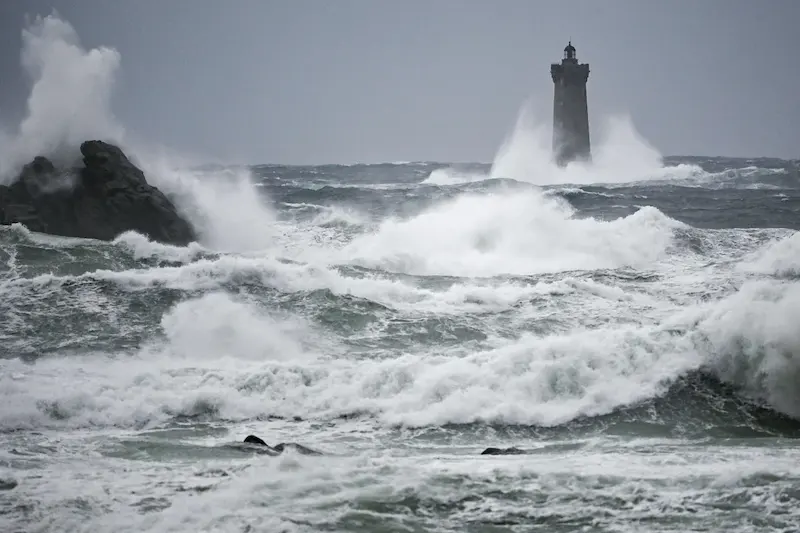


Storm Ciarán has unleashed its fury, causing widespread chaos and leaving more than a million people without electricity across France and southern England. The powerful storm, with its hurricane-strength winds, has resulted in one fatality in France and record-breaking wind speeds in the country's northwest.
In France, the department of Finistère bore the brunt of the storm, experiencing wind gusts surpassing 200kmh (124mph) and sustained winds of over 120 kilometers per hour (75 miles per hour). These extreme conditions knocked down countless trees, branches, and power lines, disrupting the entire road network. As a result, 1.2 million people in the country were left without power, with Brittany being the worst affected region. Energy supplier Enedis has mobilized a substantial workforce of 3,000 and deployed 30 helicopters to restore power to affected areas.
Tragically, Storm Ciarán claimed one life in France when a falling branch struck a driver. The destructive storm hasn't spared the British Isles either, triggering red alert warnings. Jersey, an island off the coast, swiftly closed all schools and its airport in response. Cornwall, a county in southwestern England, faced power outages affecting 8,500 individuals. Numerous roads were obstructed by fallen trees, and over 100 schools had to remain closed. Disturbing images from Cornwall documented powerful waves attempting to breach sea walls.
The UK's Met Office cautioned the public about the potential dangers posed by the combination of strong winds and heavy rain. Flying debris can become hazardous to life, while trees and homes may sustain damage. Coastal roads and properties are at risk from large waves. Consequently, disruptions to travel are expected, prompting several rail companies, including those in London, to advise against commuting. However, the Met Office updated its forecast, indicating that the storm's trajectory had shifted further south, suggesting that the strongest winds will be concentrated along coastal areas.
Storm Ciarán arrives less than a fortnight after Storm Babet, which wreaked havoc across Scotland and parts of northern and central England, causing flash flooding and claiming several lives. The increasing frequency and intensity of these storms can be attributed, in part, to the human-induced climate crisis. As the Earth's atmosphere warms, it becomes capable of holding greater amounts of water vapor, resulting in heavier rainfall during storms. Additionally, rising sea levels contribute to more destructive storm surges.
Friederike Otto, a climate science expert at Imperial College London, highlights the significance of climate change in exacerbating the impact of autumn and winter storms like Storm Ciarán. The severity of rainfall during such events is intensified, while storm surges become more damaging due to higher sea levels. These impacts are supported by numerous attribution studies and other lines of evidence, emphasizing the role of climate change in making these storms more devastating.
As Storm Ciarán continues its path of destruction, those affected are grappling with power outages, damaged infrastructure, and the tragic loss of life. Efforts to restore power and clear roads are underway, but the aftermath of this powerful storm serves as a stark reminder of the urgent need for climate action to mitigate the devastating impacts of extreme weather events.