


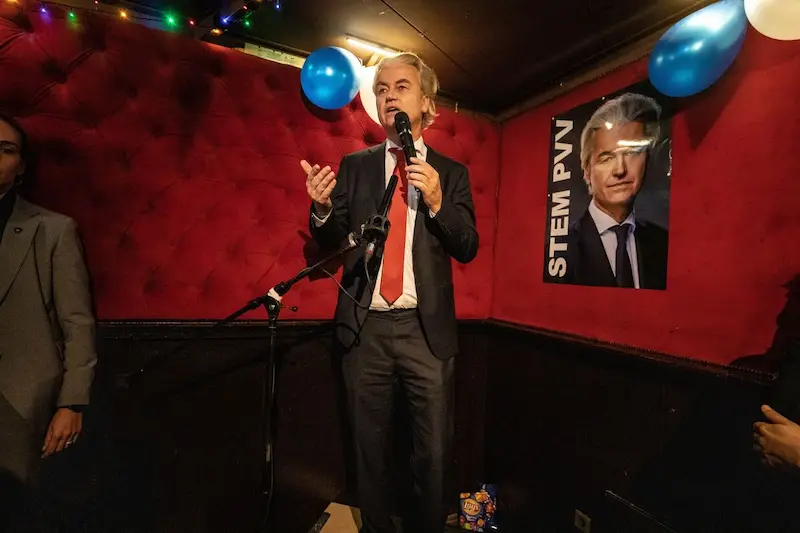


In a stunning turn of events, far-right lawmaker Geert Wilders has emerged victorious in the Dutch elections and announced his plans to lead the country's next government. This shocking result will reverberate across Europe, posing a challenge to the European Union project. Wilders's anti-EU party, the Freedom Party, secured 37 seats according to preliminary counts. This more than doubled his party's representation from the previous parliament, giving him a 12-seat lead over his closest rival.
While the market reaction remained relatively muted following the election results, traders were quick to acknowledge that coalition arrangements may take considerable time to negotiate. The formation of alliances with more centrist rivals will determine Wilders's chances of leading the next government. In his post-election speech, Wilders expressed a willingness to compromise in talks with other parties, including the liberal VVD, the party previously led by outgoing prime minister Mark Rutte, which has indicated its openness to governing alongside him.
The surge in the number of refugees, coupled with the rising costs of food and energy, has fueled support for far-right groups across Europe. Wilders, known for his anti-Islamic views, has capitalized on the polarizing issue of immigration, which resonated with voters. Immigration has become a core issue for him over the years, and his victory reflects the extent to which this issue continues to shape political landscapes.
Frans Timmermans, leading the Left alliance formed from the Green Left and Labor parties, secured the second-strongest position with 25 seats, surpassing Rutte's VVD. Another notable development was the success of a new party formed by lawmaker Pieter Omtzigt, which garnered 20 seats, according to preliminary results.
Hungarian Prime Minister Viktor Orban quickly congratulated Wilders on his victory, emphasizing the need for perseverance during upcoming political negotiations. However, it is important to note that while Wilders may lead the next Dutch government, a cautionary precedent can be found in Spain, where despite defeat in the initial election, Socialist Prime Minister Pedro Sanchez secured a third term by stitching together support from seven different parties.
If Wilders does come to power, it will mark the elevation of a euroskeptic leader in one of the EU's founding members. With calls to withdraw from climate obligations and halt aid to Ukraine, Wilders's potential influence on Dutch foreign policy could be significant.
During his campaign, Wilders presented a more moderate message compared to previous years, which appears to have resonated with voters. However, his track record in government remains limited, with his only prior participation from 2010 to 2012 when he supported Rutte's first, minority coalition from the outside. Since then, Rutte has categorically ruled out working with Wilders, particularly after the latter's controversial comments about people of Moroccan descent, which resulted in legal consequences.
As coalition-building is expected to be challenging, the outgoing caretaker government led by Rutte could potentially remain in power for an extended period. In the previous election, it took a record-breaking nine months and the involvement of four parties to form a majority government. Wilders acknowledged that his party cannot be ignored and expressed a willingness to collaborate, urging both his party and others to set aside their differences.
As the dust settles from the Dutch elections, all eyes will be on Geert Wilders and the potential political landscape that lies ahead. The repercussions of his victory will undoubtedly shape not only Dutch politics but also the future of the European Union.