


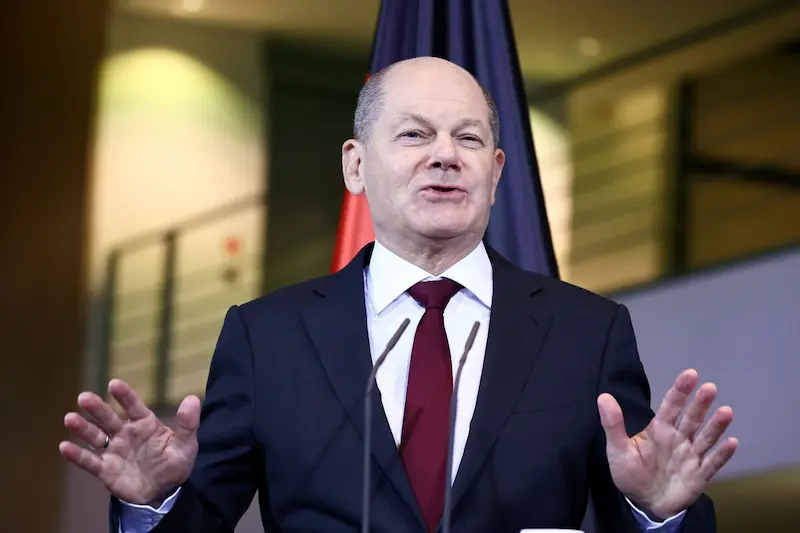


German Chancellor Olaf Scholz has moved to alleviate concerns about the repercussions of last week's ruling by the nation's top court. In a video statement released in Berlin on Friday, Scholz assured the public that his government is committed to resolving the budget turmoil caused by the judgment.
Scholz emphasized that financial aid to alleviate the burden of high energy prices will not be affected and that the court ruling allows for emergency assistance to continue. He also stated that the government remains dedicated to addressing the wider fallout from Russia's war on Ukraine, supporting Kyiv, and promoting the modernization and greening of Germany's economy.
Since the Constitutional Court delivered its unexpected judgment on November 15, Scholz and senior officials from Germany's three-party governing alliance have been engaged in emergency discussions to determine the full implications of the ruling. Finance Minister Christian Lindner has taken immediate action by freezing nearly all new federal spending for this year. He is set to present a revised 2023 finance plan next week, which will include a suspension of the limit on net new borrowing for the fourth consecutive year.
The court ruling called into question Germany's use of special off-budget funds, and Lindner is now required to retroactively account for approximately €42 billion ($46 billion) of new debt allocated to alleviate the burden of high electricity and gas prices on households and businesses. The government has yet to decide how to handle the potential impact on next year's finance plan, which was scheduled to be presented to parliament next week but has now been postponed indefinitely. Any action taken to overhaul the special funds could potentially expose the government to further legal challenges.
In his video message, Scholz made it clear that the ruling coalition will not postpone making necessary decisions and is already working to ensure that the federal government and the Bundestag (German parliament) swiftly make the required decisions for the 2024 budget.
Pressure mounted on Scholz as European Central Bank President Christine Lagarde raised concerns about the budget chaos, stating that "it is an issue for us." Lagarde emphasized the need to anticipate the fiscal space and policies that countries will adopt in order to make accurate economic projections. She expressed hope that solutions would be found soon.
Lindner echoed Scholz's message, assuring the public that solutions will be found and reiterating the government's commitment to its broader goals. He acknowledged that alternative approaches must be sought for certain objectives. Meanwhile, the upper house of parliament rejected a law proposed by Lindner aimed at promoting competitiveness and investment in climate-friendly technologies, adding to the setbacks faced by the government.
Amidst these developments, Werner Gatzer, a long-serving deputy finance minister responsible for budget planning, will be stepping down at the end of the year. He will be succeeded by Wolf Reuter, the current director general and chief economist at the ministry.
As the German government works to navigate the aftermath of the court ruling, the challenges of maintaining fiscal stability and achieving long-term goals remain at the forefront of their agenda. The focus now lies on finding solutions and charting a course forward to ensure a stable and sustainable financial future for Germany.