


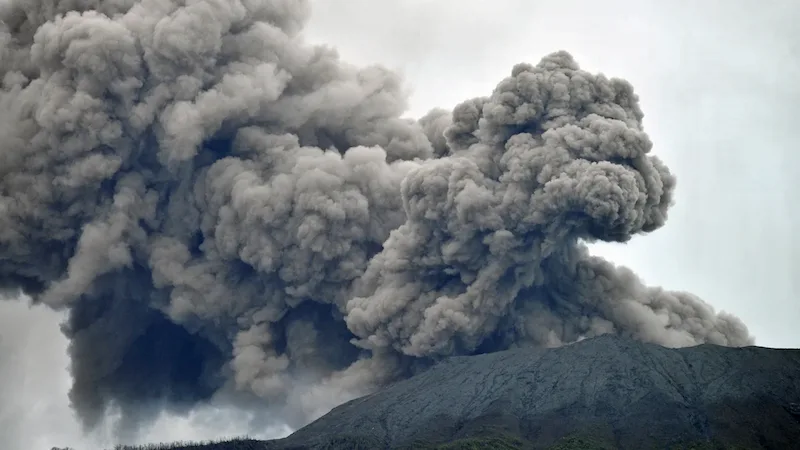


A highly active volcano in Indonesia's West Sumatra province has erupted, resulting in the deaths of eleven climbers and leaving a dozen others missing. The eruption occurred on Sunday when Mount Marapi, one of the country's most active volcanoes, spewed volcanic ash and smoke into the sky. As Indonesia is located on the Pacific Ring of Fire, it has more active volcanoes than any other country in the world.
Rescue operations are currently underway in the affected area, with a team of forty rescuers deployed on the mountain despite ongoing eruptions. So far, three climbers have been found alive, but the condition of the remaining twelve missing climbers is unknown. Approximately 75 people, including climbers, have been evacuated, and those injured have been transported to nearby hospitals.
The devastating impact of the eruption is not limited to the climbers alone. The surrounding villages, roads, and cars have also been covered in a thick layer of ash, as seen in photographs. Authorities have warned of potential dangers caused by the eruption, including flowing molten lava that may reach nearby rivers and roads.
Mount Marapi has a history of high volcanic activity, with its deadliest eruption occurring in April 1979, resulting in the deaths of 60 people. Following the recent eruption, authorities have raised the alert level to the second highest and implemented a ban on all activities within two miles of the volcano's crater. Masks have been distributed to residents in the affected area, and they have been advised to stay indoors for their safety.
As a precautionary measure, climbing routes and trails have been closed until further notice. The Indonesian National Disaster Management Agency (BNPB) is closely monitoring the volcano's movements in order to ensure the safety of residents and visitors in the region.
The eruption of Mount Marapi serves as a stark reminder of the volatile nature of Indonesia's volcanic landscape. With 127 active volcanoes scattered across the archipelago, the country is susceptible to such natural disasters. Efforts are underway to mitigate the risks associated with living in close proximity to these active volcanoes, including the distribution of safety equipment and the implementation of evacuation plans.
In moments like these, the resilience and strength of the Indonesian people are commendable. Local authorities, rescue teams, and volunteers are working tirelessly to locate and help those affected by the eruption. The nation stands united in the face of adversity, offering support and assistance to those in need.