


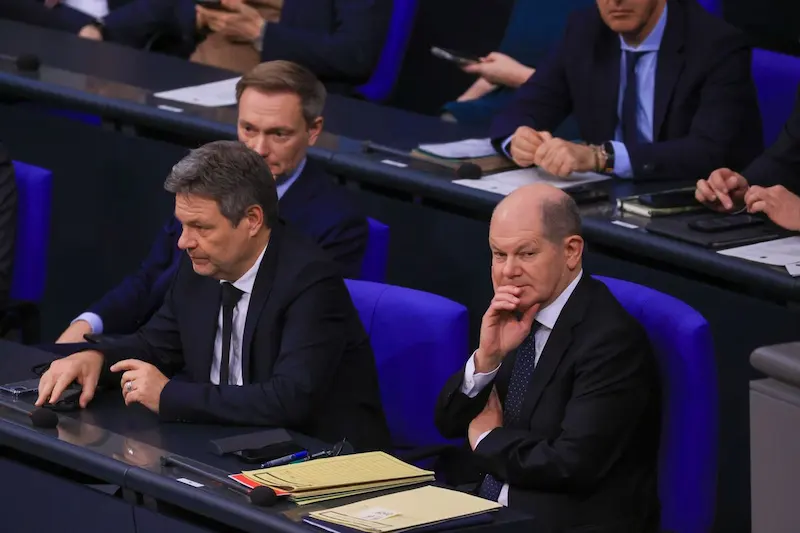


A recent survey conducted by Bild has revealed that over 59% of German voters are dissatisfied with Chancellor Olaf Scholz's coalition government and are calling for early elections. The poll, which surveyed 1,001 people, showed that a majority of respondents prefer elections for a new German parliament in 2024, rather than waiting until the scheduled fall of 2025. In contrast, only 27% opposed the idea of early elections.
The dissatisfaction with the current coalition government stems from a political crisis caused by a recent ruling by Germany's top court that limited the use of special funds outside the regular federal budget. These funds were crucial in bridging differences within the coalition, particularly regarding investment in the country's climate transition. As a result, the ruling alliance had to overhaul its finance planning, raising questions about the viability of the three-party alliance formed after the 2021 election.
To address the financial challenges, German lawmakers approved the government's motion to suspend a constitutional limit on net new borrowing in 2023 for the fourth consecutive year. However, the ongoing haggling between Scholz, Robert Habeck of the Greens, and Christian Lindner of the Free Democrats over the details further strained the coalition's cohesion.
The main opposition party, the Christian Democrats, has called on Scholz to initiate a vote of confidence in parliament, which he rejected. If the chancellor fails to secure a vote of confidence from the majority of lawmakers, he can request Germany's president to dissolve the Bundestag and call for early elections.
According to a weekly survey by Bild am Sonntag, support for the current ruling coalition among the Social Democrats, Greens, and Free Democrats stood at a meager 32% among voters. This marks a significant decline of 20 percentage points from the support they garnered in the 2021 election and represents the lowest level of support recorded for this three-party coalition.
In contrast, the Christian Democrats and their Bavarian sister party witnessed a 2-percentage point increase in support, also reaching 32%. The ruling coalition's recent electoral defeats in two influential economic regions, Bavaria and Hesse, have further intensified the pressure on Germany's fractious government.
Additionally, the growing presence of the far-right Alternative for Germany (AfD) is becoming increasingly evident. The AfD emerged as the second-strongest force in Hesse and ranked third in Bavaria, highlighting its growing national appeal.
The results of this survey underscore the deep dissatisfaction among German voters and the desire for a change in government. As the coalition grapples with internal disagreements and struggles to meet the financial challenges posed by the court ruling, early elections may become an imminent possibility. The future political landscape of Germany remains uncertain, as the country navigates through these turbulent times.