


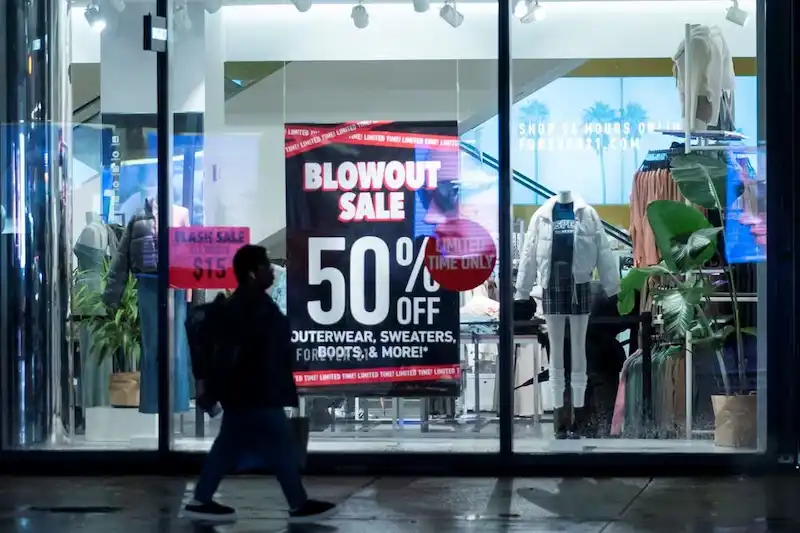


U.S. prices experienced a rare decline in November, marking the first decrease in over three and a half years. This drop in prices pushed the annual inflation rate further below 3%, paving the way for market expectations of a potential interest rate cut by the Federal Reserve in March. The report released by the Commerce Department on Friday also revealed that underlying inflation pressures continued to ease. This decline in inflation has allowed households to have more disposal income, leading to increased consumer spending and providing support to the overall economy as the year approaches its end.
The consistent resilience of the labor market has reaffirmed the durability of the economic expansion, contrary to earlier predictions of a recession in late 2022 by economists and some business executives. According to Sal Guatieri, a senior economist at BMO Capital Markets in Toronto, this year has presented Federal Reserve Chair Jerome Powell with a better outcome than expected. While the Fed may not hastily cut rates, it is highly likely that a rate cut will occur in the future.
The personal consumption expenditures (PCE) price index, which measures inflation, declined by 0.1% last month, as reported by the Commerce Department's Bureau of Economic Analysis. This marked the first monthly decline in the PCE price index since April 2020, following an unchanged reading in October. Food prices experienced a slight drop of 0.1%, while energy prices fell by 2.7%. Over the 12 months leading up to November, the PCE price index increased by 2.6%, compared to a 2.9% rise in October. This means that October was the first time since March 2021 that the annual PCE price index fell below 3%.
Excluding the volatile food and energy components, the PCE price index rose by 0.1% in November, matching the increase seen in October. The core PCE price index, which is closely monitored by the Fed, showed a year-on-year increase of 3.2%. This is the smallest rise since April 2021, following a 3.4% increase in October. The Fed aims for a 2% inflation target and tracks the PCE price measures to gauge this target.
To bring inflation back to the Fed's target, economists suggest that sustainable monthly inflation readings of 0.2% are needed. In light of the subsiding inflation rate, financial markets are now estimating a roughly 75% chance of a rate cut during the Fed's March 19-20 policy meeting, according to CME Group's FedWatch Tool.
The decline in inflation has lifted the spirits of many Americans, as consumer sentiment saw a significant boost in December, reversing all declines experienced in the previous four months, according to a report from the University of Michigan. President Joe Biden, who has faced criticism over the high cost of living, welcomed this positive news and attributed it to the collaborative efforts made to improve supply chains and create job opportunities.
As a result of the encouraging economic data, stocks on Wall Street were trading higher, while the dollar saw a decline against a basket of currencies. U.S. Treasury prices also rose.
Consumer spending, which accounts for more than two-thirds of U.S. economic activity, increased by 0.2% in November, following a 0.1% rise in October. Furthermore, when adjusted for inflation, overall consumer spending saw a 0.3% increase in November, compared to a slight rise of 0.1% in October. These positive figures reflect the start of the holiday shopping season, as Americans had more disposable income at their disposal.
Furthermore, wages in the U.S. increased by 0.6% last month, offsetting the downward impact on personal income resulting from reductions in government aid such as food stamps, social security, and Medicaid. As a result, personal income rose by 0.4%. The increase in income, coupled with an increase in the saving rate from 4.0% to 4.1%, bodes well for future spending.
Various economic indicators throughout the week, such as single-family housing starts, building permits, and the latest durable goods orders, suggest that the economy is regaining momentum after a potential slowdown at the beginning of the fourth quarter. Although there was a noteworthy decline in new home sales in November, likely due to a scarcity of previously owned houses on the market, the decrease is expected to be temporary. Additionally, declining mortgage rates, which are now lower than the levels seen in the last 23 years, should support new home sales.
The range of estimates for the fourth-quarter gross domestic product (GDP) growth varies between 1.1% and 2.8% on an annualized rate. Notably, the economy grew at a rate of 4.9% in the third quarter. As Gus Faucher, chief economist at PNC Financial, states, the U.S. economy seems to be in good shape heading into 2024, with no recession predicted for the year.