


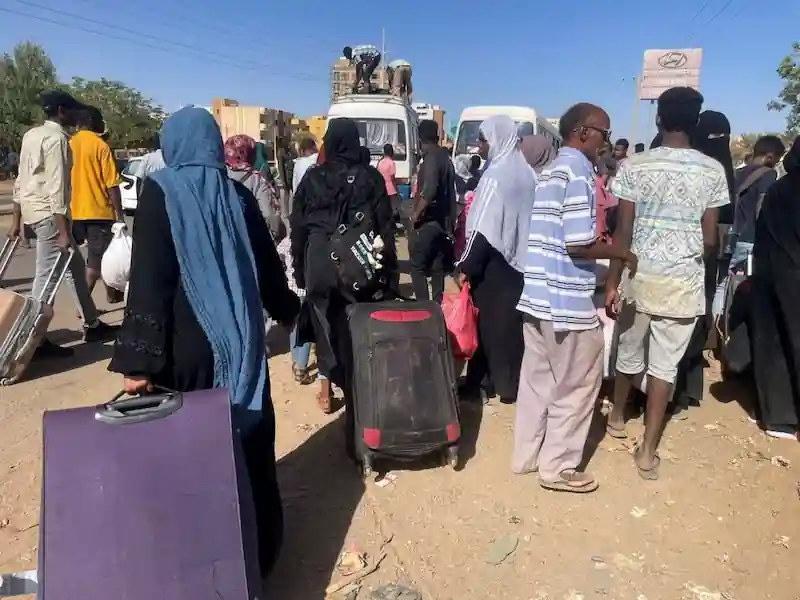


The United Nations Secretary-General, Antonio Guterres, has made an appeal to the warring factions in Sudan, urging them to observe a ceasefire during the Muslim Eid al-Fitr holiday. The violence, which has continued for six days, has led to thousands of civilians fleeing from the capital city, Khartoum, to Chad, while the United States has announced the deployment of more troops to the region. The conflict erupted between two previously allied leaders of Sudan's ruling military junta, with more than 330 people having been killed so far. The fiercest battles have been around Khartoum, one of Africa's largest urban areas, and in Darfur, where a long-standing conflict ended only three years ago.
In a virtual meeting with the heads of the African Union, the Arab League, and other organisations, Guterres expressed a strong consensus to condemn the ongoing fighting in Sudan and called for an immediate cessation of hostilities. The civilians trapped in conflict zones should be allowed to escape and seek medical treatment, food, and other supplies. The Sudanese army's chief, Abdel Fattah al-Burhan, has stated his support for a truce on the condition that it allows citizens to move freely, which the RSF has so far prevented. He also sees no partner for negotiations and no other option but the military solution.
In contrast, the RSF leader, General Mohamed Hamdan Dagalo, has expressed his readiness to implement a three-day truce over the Eid al-Fitr holiday. Dagalo, also known as Hemedti, has previously supported short ceasefires, but each has quickly collapsed. He stressed that the truce would be humanitarian, allowing for safe passages and the escape of trapped civilians. He referred to Burhan as a criminal, to which Burhan accused Dagalo of a power grab.
The most recent violence was triggered by disagreement over an internationally-backed plan to form a new civilian government. Both sides have accused the other of thwarting the transition. The fighting focused on the compound housing the army HQ and Burhan's residence, the embassy district, and the airport. The residents of the cities of El-Obeid, east of Darfur, have also reported clashes between the army and RSF troops and widespread looting.
The World Health Organisation has urged the combatants to open a safe corridor for medics and allow those trapped to flee. Around 10,000 to 20,000 people who have escaped the fighting have taken refuge in villages along the border inside Chad. Even before the conflict, around a quarter of Sudan's population faced acute hunger, and the WFP halted one of its largest global operations in the country on Saturday after three workers were killed.
Sudan borders seven countries and sits strategically between Egypt, Saudi Arabia, Ethiopia, and Africa's volatile Sahel region, risking fanning regional tensions. Chad has reported that it has stopped and disarmed a Sudanese contingent of 320 soldiers. The RSF has returned Egyptian troops it captured at the northern Merowe base over the weekend. The RSF has up to 100,000 troops, while the army has artillery and war planes and controls access to Khartoum. The army is trying to cut supply routes to RSF fighters, according to residents and witnesses.
In an interview with the Financial Times, Burhan said that much of the RSF was now "out of control," accusing fighters of looting and attacking foreign diplomats and aid workers. The United States has also mentioned that it had preliminary indications that the RSF was responsible for an attack on its diplomats. Witnesses have reported that RSF gunmen have been involved in looting and attacks on aid workers. Separately, Dagalo told the FT that the armed forces were responsible for hitting hospitals and non-military targets, as well as the attacks on "diplomats and guests." The Pentagon announced that it was deploying additional forces to the region to evacuate U.S. Embassy personnel from Sudan if circumstances required it.