


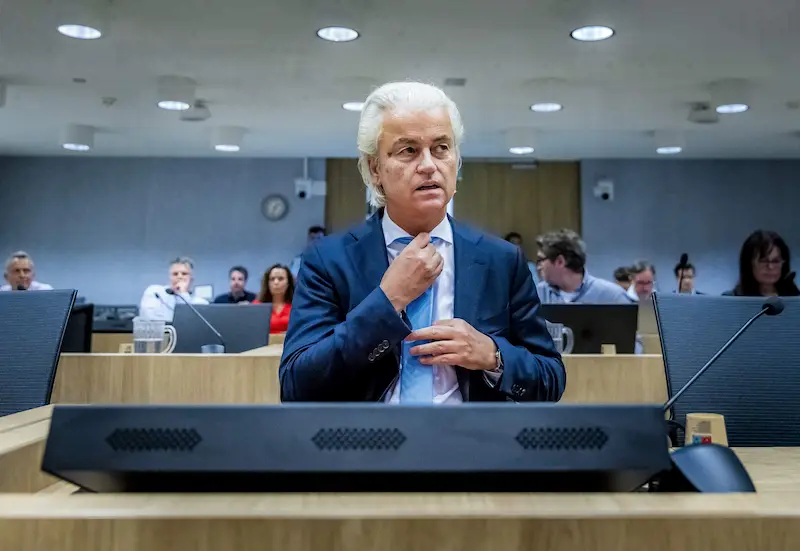


Dutch politician Geert Wilders, known for his far-right views, has made the decision to withdraw several controversial bills in an effort to win support from centrist parties for a potential coalition. Among the retracted proposals are a ban on the Koran, an administrative detention law, curbs on the right to vote, and a ban on multiple nationalities for certain candidates. Wilders, leader of the Freedom Party, emerged as a surprise victor in the November elections, securing more seats than predicted. He is currently negotiating with right-wing parties, including the VVD and the New Social Contract, for a potential coalition government.
While the VVD has ruled out participating in Wilders' cabinet, they have shown willingness to offer parliamentary support. However, the leader of the New Social Contract party, Pieter Omtzigt, who holds crucial influence in Wilders' bid for prime minister, previously requested clarification on some of Wilders' stances that he believed ran counter to the constitution. This implies that Wilders will need to make further concessions in order to gain the necessary support for his political ambitions.
While enforcing stricter immigration policies may be an area where the four parties can find common ground, other issues such as assistance to Ukraine, cooperation with the European Union, and climate policies may prove to be obstacles during negotiations. Despite this, recent polls indicate a growing level of support for Wilders' Freedom Party, which may strengthen his position in the coalition talks.
Wilders has shown a willingness to tone down his far-right policies in order to strike compromises with other parties. Following his election victory, he stated, "Some say I am the Dutch Trump, others call me Geert Milders. The truth is somewhere in the middle." This indicates his understanding of the need to appeal to a broader base and suggests a willingness to adopt more moderate positions.
As coalition talks continue, it remains to be seen how successful Wilders will be in his efforts to form a right-wing coalition. The withdrawal of these controversial bills is a strategic move to appear more palatable and build a broader coalition of support. The coming weeks will be crucial in determining whether Wilders can navigate the complexities of Dutch politics and form a government that aligns with his party's agenda.