


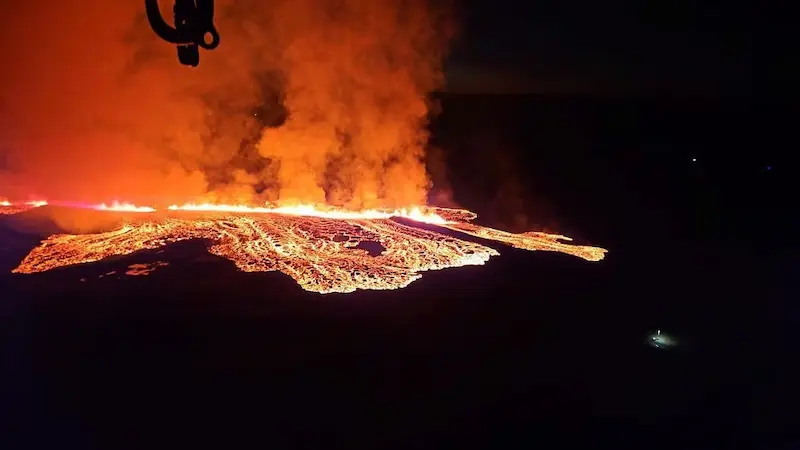


A volcanic eruption in southwest Iceland has unleashed a flow of molten lava, causing some houses to catch fire on the outskirts of a small fishing town. Fortunately, the town had been evacuated earlier, ensuring the safety of residents. Fountains of molten rock and smoke emerged from fissures in the ground, reaching the town of Grindavik, where at least one house was seen on fire in live video footage. Despite this, Iceland's President, Gudni Johannesson, assured the public that there was no immediate danger to human life, although he acknowledged the possible threat to infrastructure. He further mentioned that the eruption had not disrupted any flights.
The eruption began on Sunday morning, located north of Grindavik. The town had been evacuated for the second time since November due to concerns of an imminent volcanic outbreak, prompted by heightened seismic activity in the area. In recent weeks, authorities had erected barriers made of earth and rock to impede the flow of lava towards Grindavik. However, these defensive measures proved ineffective as the latest eruption successfully breached the town's defenses.
The Blue Lagoon, a popular geothermal spa in close proximity to the area, also announced its closure on Sunday. This recent eruption marks the second volcanic event in less than a month in the Reykjanes peninsula in southwest Iceland. It also represents the fifth eruption since 2021.
Iceland is characterized by its geologically active landscape, with more than 30 active volcanoes scattered across the island. Consequently, it has become a favored destination for volcano tourism, drawing numerous adventure seekers. However, the country has experienced significant volcanic events in the past. In 2010, the Eyafjallajokull volcano in southern Iceland caused ash clouds that disrupted air travel across Europe, leading to the evacuation of many residents.
Unlike the Eyafjallajokull volcano, the Reykjanes volcanic systems are not located beneath glaciers, reducing the likelihood of ash clouds causing similar disruptions in air travel. Nonetheless, the inhabitants of Grindavik have faced repeated evacuations and anxieties due to the ongoing volcanic activity. The situation highlights the delicate balance between harnessing the natural beauty of Iceland's volcanic landscapes for tourism while ensuring the safety of local communities.