


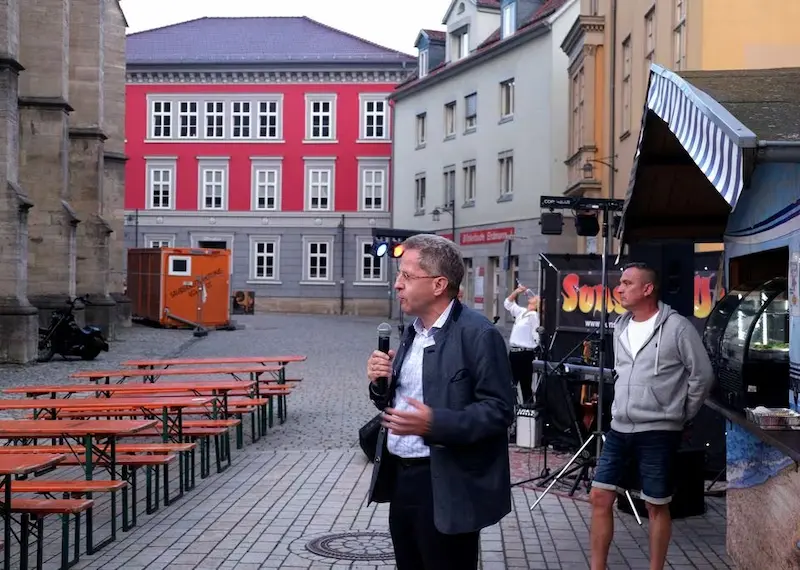


In a move that further fragments Germany's political landscape, the right-wing conservative group Werteunion (Values Union) has announced its intention to establish a new political party. The decision was made during a closed party meeting in Erfurt, where members granted Chairman Hans-Georg Maassen a mandate to initiate the founding of a "conservative-liberal" party. Maassen, a former domestic security official known for his anti-immigration stances, enjoys popularity among like-minded voters.
The Werteunion aims to expedite the process and establish the new party before the upcoming state elections in Thuringia, Saxony, and Mecklenburg-Western Pomerania, set to take place in September. Sources familiar with the matter suggest that the party's formation could potentially occur as early as February.
The move follows the pattern of Germany's political landscape becoming increasingly fragmented, notably with the emergence of the Alternative for Deutschland (AfD) party eleven years ago. The rise of AfD has depleted the voter shares of traditional powerhouses such as the Social Democratic Party (SPD) and the Christian Democratic Union (CDU).
Adding to the political splintering, Sahra Wagenknecht, a prominent figure on Germany's far left, recently launched her own party in early January. With these new parties entering the fray, the established political order faces a growing challenge in maintaining stability and coherence.
It is worth noting that members of the Werteunion recently participated in a conference alongside right-wing extremists in Potsdam, raising concerns about the ideological inclinations and affiliations of the yet-to-be-formed party. This association with extremist groups could further deepen divisions within German society and impact the political landscape in unforeseen ways.
As the process of founding a new party gains momentum, Germany will closely watch the developments taking place within the Werteunion. The emergence of yet another political force will undoubtedly reshape the already shifting political dynamics in the country and potentially heighten polarizations, as voters seek alternative options beyond the traditional power players.