


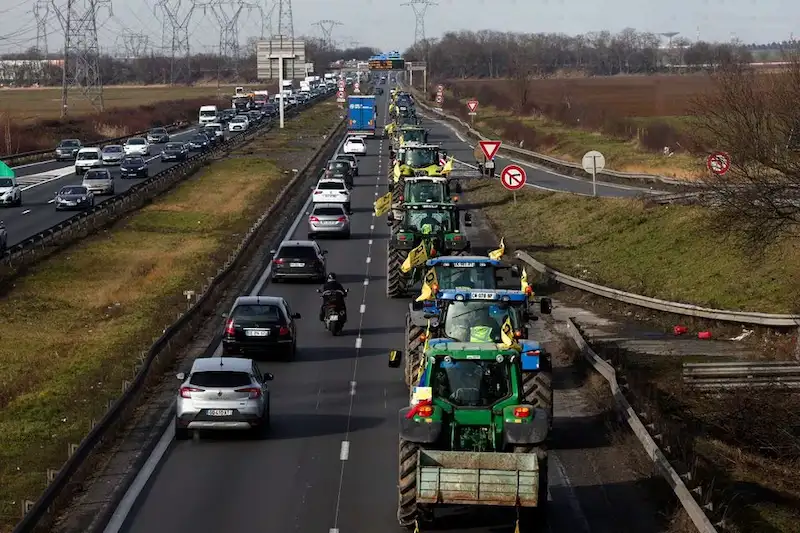


France is tightening security measures ahead of nationwide protests by farmers who are demanding better pay and improved living conditions. Farmers in France, the largest agricultural producer in the European Union, have expressed concerns over unfair competition from countries with less regulatory oversight. In recent days, they have erected roadblocks on highways and caused damage to local government offices to draw attention to their plight.
Several farmers' unions have called for protesters to block transportation routes in and around Paris, and to target the Rungis food market located near the capital. One farmer, Daniel Faucheux, explained his intention to encircle Paris accompanied by a convoy of vehicles and tractors. In response to these calls for action, the Paris police have announced increased security measures around Rungis and the Paris Roissy airport. Videos have also been shared on social media showcasing armored police vehicles being stationed near Rungis.
Interior Minister Gerald Darmanin clarified that the heightened security measures are meant to prevent tractors from entering Paris. However, he also cautioned that disruptions are expected in the Ile-de-France region, encompassing Paris and its suburbs. Darmanin revealed that approximately 15,000 police officers will be deployed as part of the security operation to manage the protests.
Darmanin further acknowledged that these protests and roadblocks are causing economic consequences, negatively impacting the region's economic growth. The French farmers' protests are part of a larger trend, as similar actions have been observed in other European countries including Germany and Poland. These protests come ahead of the European elections in June, where far-right parties are projected to make gains by appealing to farmers who feel marginalized.
Marine Le Pen, the leader of the French far-right National Rally and President Emmanuel Macron's main opponent, visited the farmers' demonstrations in northern France. Le Pen emphasized the need to withdraw agriculture from free trade agreements, indicating her support for the farmers' cause. As a response to the protests, the government dropped its plans to gradually reduce agricultural diesel subsidies and announced additional measures to alleviate financial and administrative burdens faced by farmers. However, these steps have not fully satisfied the farmers, who continue to demand more support.