


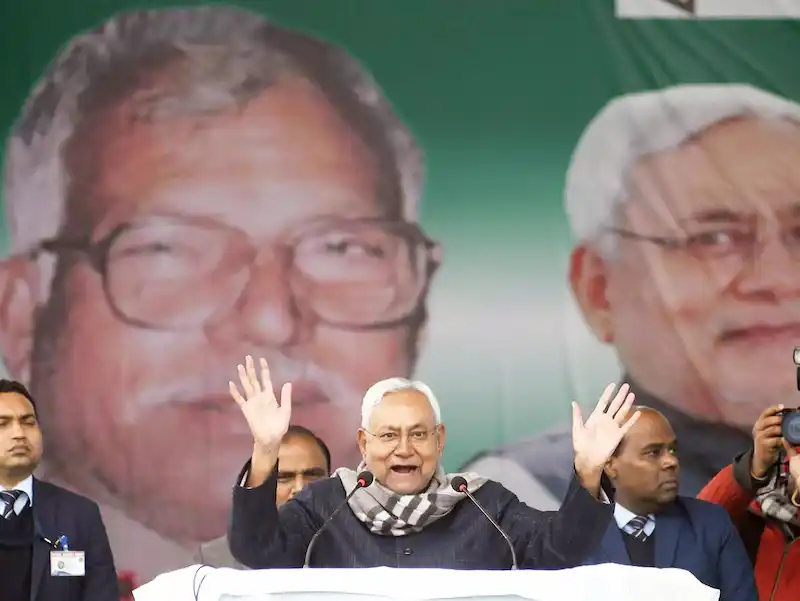


In a significant blow to the opposition unity in India, Nitish Kumar, a key figure in the alliance of 28 political groups, has switched sides to form a new regional government with the support of Prime Minister Narendra Modi's party. Kumar, who had been leading a government with the backing of various regional parties since August 2022, resigned as the chief minister of Bihar, an eastern Indian state with a population larger than any European Union nation. As a result, Kumar has now taken oath for a record ninth term and aligned with Modi's Bharatiya Janata Party once again, marking a setback for the opposition coalition's plans to challenge Modi in the upcoming national elections.
According to the Press Trust of India, Kumar cited the deteriorating relationship between his party, Janata Dal (United), and its main partner, Rashtriya Janata Dal, as the reason for his resignation and subsequent negotiations with the Bharatiya Janata Party. This move marks a realignment in Bihar's political landscape, as Kumar and Modi's parties had previously formed a coalition to retain power after state elections in November 2020, but had severed ties in 2022. The timing of this development is crucial, as Modi is seeking a third five-year term as India's Prime Minister, buoyed by a rapidly growing economy and a stock market that has surpassed Hong Kong to become the world's fourth-largest.
The switch in allegiance by Nitish Kumar not only undermines the opposition's attempt to present a united front against Modi but also raises questions about the stability of the newly formed alliance. Kumar had been seen as a key member and even the convener of the opposition coalition, which aimed to challenge Modi's ruling party in the upcoming national elections. With Kumar's departure, the alliance is left without a prominent leader and will need to regroup and reassess its strategy moving forward.
This development also highlights the fluid nature of Indian politics, where alliances and allegiances can shift quickly in response to changing circumstances. Kumar's decision to align with Modi's party, despite their past differences, underscores the complexities and pragmatism inherent in Indian politics. The move may be viewed as a strategic maneuver by Kumar to secure his political position and maximize his chances of remaining in power.
For Modi, the addition of Kumar and his party to the ruling coalition in Bihar provides a significant boost to his election prospects. The state holds considerable electoral weight, sending 40 lawmakers to the Indian Parliament. The alliance with Kumar's party strengthens Modi's position in Bihar and expands his base of support, which can prove crucial in securing a third term in office.
As India gears up for the national elections in the first half of this year, the political landscape has been reshaped by Nitish Kumar's switch in allegiance. With this turn of events, the opposition alliance faces an uphill battle in regaining momentum and uniting against the popular incumbent Prime Minister. Meanwhile, Modi's prospects are further bolstered by a robust economy and a flourishing stock market, offering him a favorable backdrop for his electoral campaign. The political climate in India remains dynamic, and the coming months will determine the trajectory of the nation's leadership and governance.