


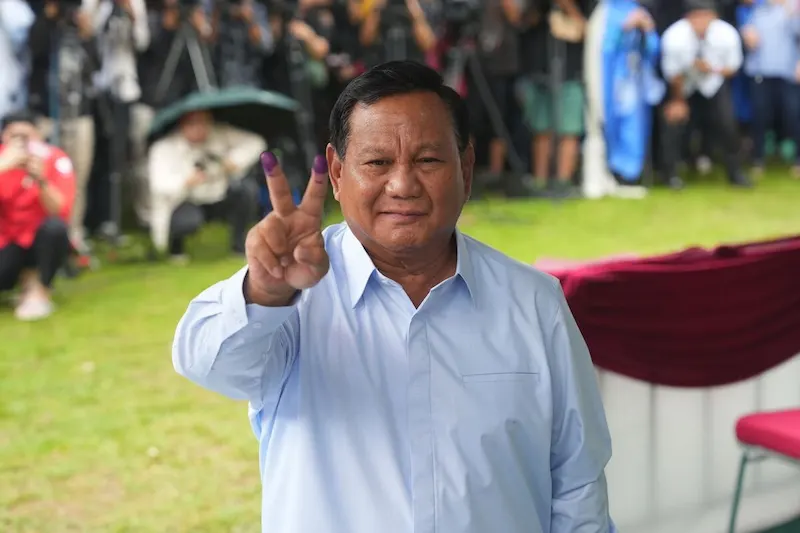


Former Indonesian Defense Minister Prabowo Subianto has declared victory in the country's presidential vote, signaling a breakthrough after two failed attempts. The 72-year-old ex-general, along with his running mate Gibran Rakabuming Raka, celebrated the early results by waving to thousands of supporters in a victory rally. According to quick counts conducted by independent pollsters, including Litbang Kompas, Indikator Politik Indonesia, Lembaga Survei Indonesia, and CSIS Indonesia-Cyrus Network, Prabowo secured nearly 60% of the support. It is worth noting that official results will be announced in the coming days or weeks.
Prabowo's main competitors, former Jakarta Governor Anies Baswedan and former Central Java Governor Ganjar Pranowo, have urged their respective supporters to wait for the official results, refraining from conceding defeat at this stage. Under the election rules, the victor must obtain over 50% of the total votes and secure at least 20% of the votes in over half of Indonesia's provinces.
The swift victory of Prabowo and Gibran is expected to bring stability to the country and positively impact Indonesian stocks and the local currency. The offshore rupiah has already experienced a rise of up to 0.5% against the dollar. In his victory speech, Prabowo appealed for unity, stating that "this victory must be a victory for all Indonesians." He thanked a multitude of allies, including military personnel, and paid tribute to past leaders. Interestingly, it was his ties with the incumbent President Joko Widodo, popularly known as Jokowi, that led to the crowd chanting the president's name. Notably, Prabowo's son, Gibran, is now his vice president, further solidifying the connection between the two politicians.
The results reported by private pollsters are based on samples from more than 800,000 polling stations across the country. These quick counts provide an early indication of the official results. Prabowo has positioned himself as a candidate who will continue Jokowi's business-friendly economic agenda, striving to transform Indonesia into a high-income economy by 2045. Key priorities include optimizing Indonesia's vast natural resources, enhancing infrastructure, and relocating the capital to Borneo.
The victory of Prabowo, the former son-in-law of the late dictator Suharto, is partially attributed to his extensive image makeover on social media platforms. He has shed his fiery nationalist image and is now portrayed as an affable grandfatherly figure. Among his promises is the provision of free lunches for approximately 83 million students, an endeavor that would cost around 300 trillion rupiah ($19 billion) annually—almost equivalent to the projected budget deficit for 2023.
Indonesia's next president will assume leadership of a $1-trillion economy that has quickly risen in the global resource supply chain under Jokowi's administration. The outgoing president's focus on exporting refined commodities, rather than raw materials, has bolstered exports, reduced the fiscal deficit, and stabilized the currency. As the new president, Prabowo will face the critical task of job creation for the country's sizable youth population, while also managing supply chain disruptions and transitioning to greener energy sources, reducing reliance on coal. Additionally, he must navigate regional security concerns amidst the escalating tensions between the United States and China.
While Prabowo has promised to continue Jokowi's policies, his presidency will mark a new era rather than a third term for his predecessor. The level of influence Jokowi will wield remains uncertain, as there is no precedent for a former president substantially influencing their successor. As the situation develops, it will be crucial to monitor governance and rule of law-related developments, given Prabowo's controversial past and the potential for dynastic politics to emerge under his leadership.