


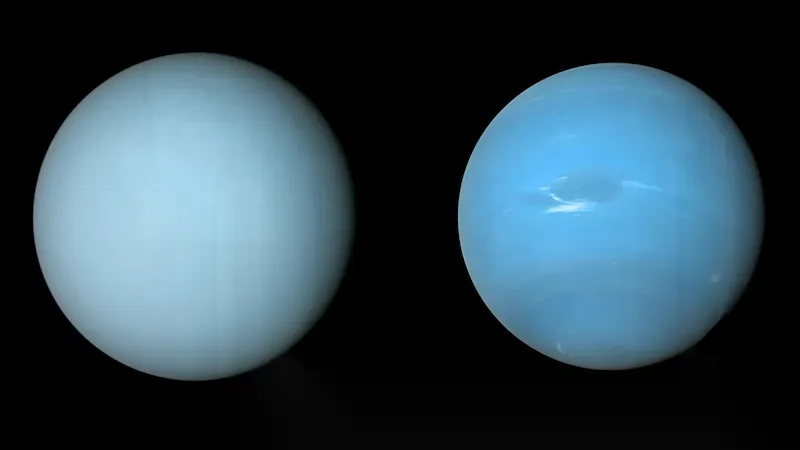


In a remarkable astronomical discovery, scientists have unearthed three previously unknown moons orbiting Uranus and Neptune, the distant ice giant planets at the outer edges of our solar system. These findings mark a significant advancement in our understanding of these elusive planets and open up new possibilities for future exploratory missions. The detection of these faint moons, made possible through advanced image processing techniques, sheds light on the dynamic and complex moon systems of Uranus and Neptune.
Among the new discoveries is a tiny moon encircling Uranus, the 28th satellite observed around the planet. Measuring a mere 5 miles across, this newly found moon, designated as S/2023 U1, takes 680 Earth days to complete a single orbit around Uranus. Following tradition, this diminutive satellite will eventually be named after a character from Shakespearean literature, adding to the poetic charm surrounding Uranus' moon system.
For Neptune, two new moons have been identified, bringing the total count to 18 known natural satellites. One of these moons, S/2002 N5, with a diameter of 14 miles, orbits Neptune over nearly nine years. The other, S/2021 N1, about 8.7 miles across, follows a lengthier orbit spanning approximately 27 years around the distant planet. These faint Neptunian moons were first spotted in 2021 and confirmed through meticulous observations conducted over several years with telescopes like the Subaru telescope in Hawaii.
The discovery of these moons not only expands our knowledge of the moon systems around Uranus and Neptune, but also provides valuable insights into the formation and evolution of the outer planets in our solar system. By analyzing the unique angular orbits of these moons, astronomers hypothesize that they were captured by the gravitational pull of the giant planets during the early stages of their formation. This discovery underscores the shared characteristics of outer moons orbiting the giant planets and offers clues to the tumultuous early history of our solar system.
The intricate dance of moons around Uranus and Neptune hints at a complex interplay of celestial forces, possibly involving collisions and disruptions that shaped their present-day configurations. As scientists continue to unravel the mysteries of these distant worlds, each new moon discovery adds another piece to the puzzle of our solar system's dynamic past. This latest breakthrough in uncovering faint moons around Uranus and Neptune paves the way for further exploration and research into these enigmatic ice giant planets, sparking excitement and curiosity within the scientific community and beyond.