


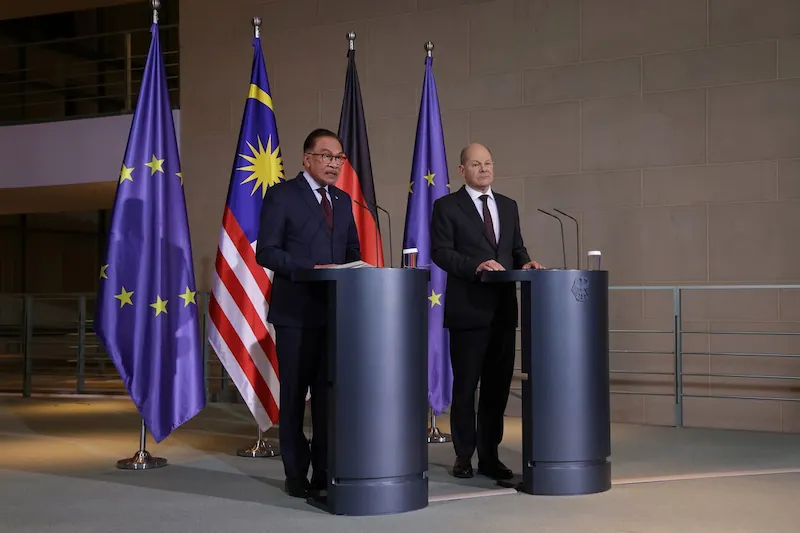


German Chancellor Olaf Scholz is strategically looking towards Thailand, Malaysia, and the Philippines to broaden economic partnerships and decrease dependency on China. With Germany's economy seeking diversified trade relations in Asia, Scholz is set to engage in discussions with leaders from these Southeast Asian nations in Berlin this week. The aim is to enhance economic resilience by establishing more varied supply chains and raw-material partnerships, minimizing one-sided reliance on China.
Despite attempts to shift focus away from Beijing, China remains Germany's top trading partner in 2023, marking the eighth consecutive year of this trend. This enduring economic relationship is particularly prominent in sectors such as automotive and chemicals. Major German companies like Volkswagen AG and BASF AG continue to view China as a crucial market, while also heavily relying on the country for raw materials essential in manufacturing high-tech products like electric-vehicle batteries and solar panels.
During discussions held on Monday, Scholz and Malaysian Prime Minister Anwar Ibrahim explored opportunities for collaboration in renewable energies and green hydrogen. Emphasizing the goal of expanding this partnership, Scholz highlighted the importance of diversifying economic ties globally. The upcoming talks with Philippine President Ferdinand Marcos and Thai Prime Minister Srettha Thavisin will further delve into fostering raw-material partnerships, skilled worker exchange, and strengthening free trade agreements.
In addition to economic cooperation, the discussions will touch upon regional security dynamics in the Indo-Pacific region, Russia's invasion of Ukraine, and the ongoing Middle East conflict. Scholz's administration has recently introduced a new China strategy that urges German corporations to assess and mitigate risks associated with their operations in China. This approach falls within the broader framework of recalibrating Germany's relations with China, recognizing elements of competition and cooperation in their partnership.
While seeking enhanced ties with ASEAN nations is a step towards diversifying economic relations away from China, it is crucial to acknowledge the vast difference in market size between the two regions. China's population surpasses 1.4 billion, markedly influencing trade dynamics compared to the 670 million inhabiting ASEAN countries. As Germany navigates its economic strategy in the coming years, balancing relationships with both China and ASEAN partners will remain a nuanced challenge in the pursuit of diversified and resilient trade networks.