


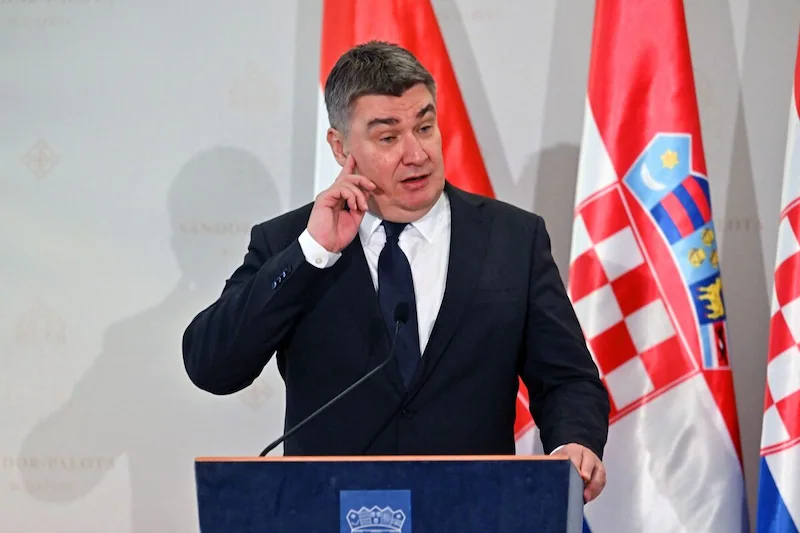


In a bold move that has sparked a constitutional clash in Croatia, President Zoran Milanovic's sudden decision to enter the upcoming election as a candidate for prime minister has been met with opposition from the country's highest court. The Constitutional Court in Zagreb ruled that Milanovic cannot campaign for the premiership while retaining his role as president, stating that such actions are "irreconcilable" with his responsibilities as the head of state.
The court's decision on Monday has thrown the already contentious election campaign into disarray, with Milanovic now facing the dilemma of either stepping down as president or halting his bid for the prime ministership. Despite the ruling, Milanovic defiantly expressed his intention to continue his campaign, labeling the court's decision as a "coup" aimed at thwarting the will of the Croatian people.
Addressing a crowd in Vela Luka, a coastal village, Milanovic denounced the court's ruling as an attempt to undermine his candidacy and pledged to become the next prime minister regardless of the obstacles in his path. He accused his critics of being "illiterate mobsters" and vowed to defy their attempts to impede his political ambitions.
The standoff between President Milanovic and the Constitutional Court has raised concerns of a potential constitutional crisis in Croatia. The court's head, Miroslav Separovic, emphasized that Milanovic's actions have already violated the country's constitution and called for measures to prevent further escalation of the situation.
As Croatia braces for a pivotal election on April 17th, the outcome of this political turmoil remains uncertain. With Milanovic leading the opposition Social Democrats and Prime Minister Andrej Plenkovic seeking a third term with the Croatian Democratic Union, the country faces a critical juncture with far-reaching implications for its future direction.
The prospect of a Milanovic premiership introduces a new dynamic to Croatia's political landscape, with potential implications for the country's stance on European and international issues. With his history of controversial statements and critical views on EU policies, Milanovic's potential leadership could mark a shift in Croatia's foreign relations and internal governance.
As the tension between President Milanovic and the Constitutional Court continues to simmer, Croatia finds itself at a crossroads, navigating the complexities of law, politics, and public opinion in the lead-up to a pivotal election. The outcome of this constitutional clash will undoubtedly shape the country's future trajectory and political landscape in the months and years to come.