


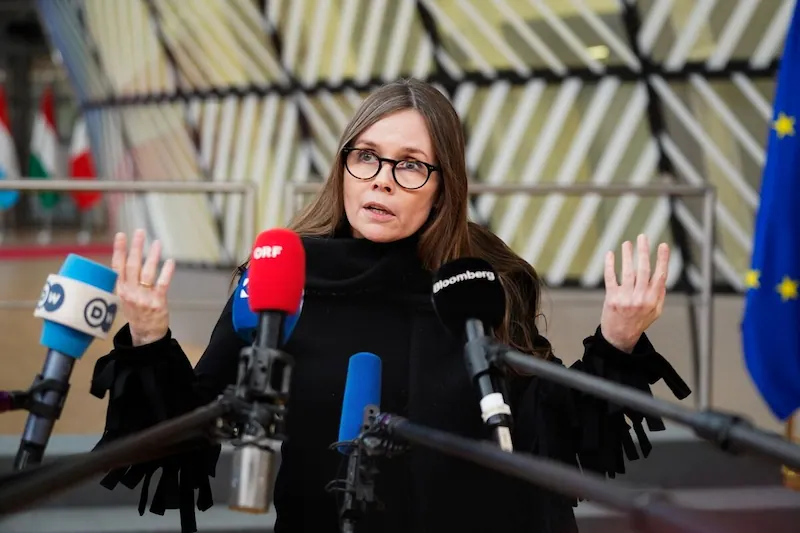


Iceland’s Prime Minister, Katrin Jakobsdottir, has announced her decision to step down from her position a year ahead of the next general election in order to run for the presidency. This move has sparked speculation and uncertainty regarding the future leadership of the country, as it remains unclear who will succeed her in leading the three-party coalition government.
Jakobsdottir, a prominent figure in Icelandic politics and a champion of environmentalist causes, stated that the values of democracy, human rights, and the rule of law are paramount for the Icelandic society. Her decision to run for president comes at a time when these values are perceived to be under threat, both locally and globally.
The 48-year-old Prime Minister has led a coalition of diverse parties, including her Left Green Movement, the right-wing Independence Party, and the centrist Progressive Party. However, recent challenges such as volcanic eruptions and wage negotiations have tested the resilience of her government. Despite these obstacles, Jakobsdottir emphasizes that no one individual is indispensable and that the focus should be on upholding the government's commitments.
As discussions commence on the future of the coalition government, the potential impact of Jakobsdottir's departure on the political landscape of Iceland remains to be seen. Her popularity has seen fluctuations, with recent polls indicating a decline in support for her party. Nevertheless, Jakobsdottir's decision to pursue the presidency reflects her ongoing commitment to public service and advocacy for crucial societal values.
If elected as president in the upcoming June 1st ballot, Jakobsdottir would become the second female president in Iceland's history, following Vigdis Finnbogadottir's election in 1980. Competing against formidable opponents such as political scientist Baldur Thorhalsson and former Reykjavik mayor Jon Gnarr, Jakobsdottir's bid for the presidency marks a pivotal moment in Icelandic politics.
With a background in linguistics and a diverse range of government experience, Jakobsdottir's unconventional path to the presidency underscores her dedication to public service and her unwavering commitment to shaping the future of Iceland. As the country navigates this period of transition, the outcome of the upcoming presidential election will undoubtedly play a crucial role in determining the trajectory of Iceland's political landscape.