


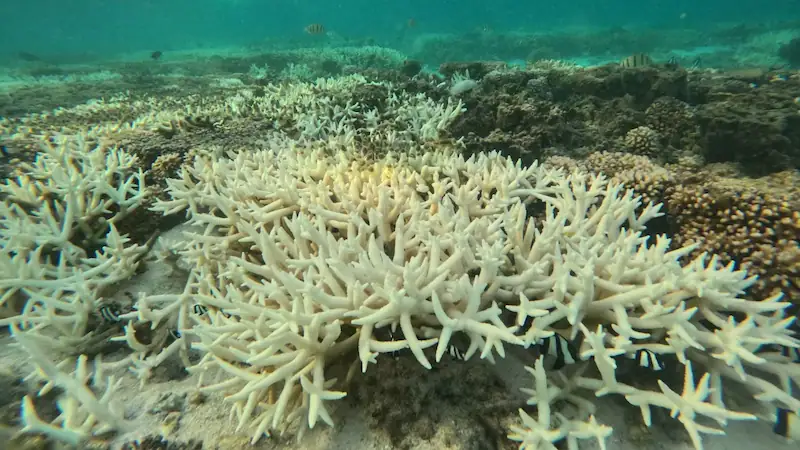


In a grave indication of escalating climate crisis impacts, coral reefs worldwide are currently engulfed in an unparalleled mass bleaching event attributed to record-breaking ocean heat levels. Recent findings by the National Oceanic and Atmospheric Administration (NOAA) and The International Coral Reef Initiative (ICRI) reveal that over 54% of the world's coral reef regions have undergone bleaching within the past year, affecting 53 countries and territories across the Atlantic, Pacific, and Indian Oceans. With this distressing trend intensifying at a rate of approximately 1% per week, experts caution that this may constitute the most severe bleaching event ever documented.
As ocean temperatures soar, coral reefs are succumbing to stress-induced bleaching, a phenomenon triggered by marine heatwaves causing corals to expel the algae living within them. These algae, crucial for their coloration and energy supply, are ejected under duress, leading to potential mass coral mortality if normal oceanic conditions fail to resume. Such coral deterioration poses a perilous threat to diverse marine species and ecosystem integrity, jeopardizing the intricate food chains reliant on coral reef vitality.
This distressing manifestation marks the fourth global bleaching occurrence and the second within a decade, following previous events in 1998, 2010, and between 2014-2017. Regions succumbing to mass bleaching in the past year encompass a vast expanse, spanning from Florida and the Caribbean to Mexico, Brazil, Australia, the South Pacific, the Red Sea, the Persian Gulf, Indonesia, and the Indian Ocean, including the coast of Africa and the Seychelles. The global diffusion of this phenomenon underscores its pervasive and alarming repercussions across diverse coral habitats worldwide.
Renowned climate scientist Professor Ove Hoegh-Guldberg, specializing in coral reefs at the University of Queensland, had forewarned of this looming mass bleaching event months ago, expressing concern over the unprecedented pace of sea temperature escalation. With the past year recording the warmest planetary conditions on record and the oceans registering unprecedented heat surges, the urgency to address this escalating crisis intensifies. Recent data from the European Commission's Copernicus Climate Change Service has highlighted record-high global sea surface temperatures, underscoring the acute nature of the environmental predicament confronting coral reefs.
While there is a glimmer of hope in the potential onset of La Niña, El Niño's cooling counterpart, forecasted by NOAA to possibly manifest between June and August this year, the specter of bleaching events persisting during La Niña looms large. Concerns regarding the impending 2024 summer, particularly for the wider Caribbean and Florida, are mounting, adding urgency to the imperative of swiftly mitigating climate change impacts on vulnerable coral reef ecosystems. As the world grapples with an existential threat to coral reefs, urgent collaborative action to curtail carbon emissions and enhance local and regional reef management practices becomes imperative to safeguard these invaluable marine ecosystems and the communities reliant on their ecological services.
In conclusion, the escalating global coral bleaching event serves as an evocative call to action, underscoring the imperatives of climate mitigation, ecosystem conservation, and sustainable management practices to avert irreversible damage to coral reefs. As a critical linchpin of marine biodiversity and coastal resilience, the protection of coral reefs assumes paramount importance in safeguarding both ecological balance and human well-being. The urgency to address the root causes of climate change and bolster conservation efforts resonates more poignantly than ever, emphasizing the need for concerted global action to preserve the irreplaceable wonders of coral reef ecosystems for present and future generations.