


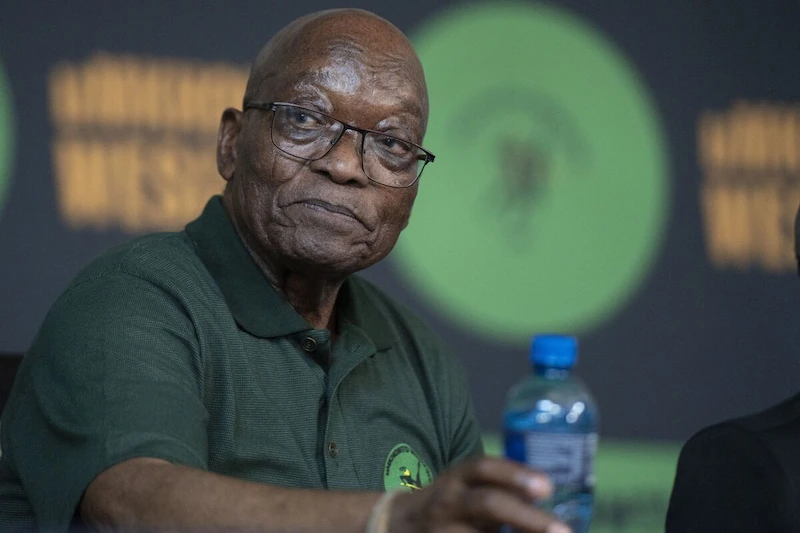


Former South African President Jacob Zuma's newly formed political party, the Umkhonto WeSizwe Party, has unveiled a bold manifesto ahead of the upcoming elections on May 29. The party's campaign promises include the nationalization of land and banks, a withdrawal from the International Criminal Court, and an expansion of the social security net. These proposals signal a shift towards a more leftist platform, similar to that of the Economic Freedom Fighters (EFF), South Africa's third-largest party.
Recent opinion polls indicate that the Umkhonto WeSizwe Party is gaining traction and siphoning support away from the ruling African National Congress (ANC), which has governed South Africa since the end of apartheid. There is a possibility that the ANC may lose its majority for the first time, as voters are drawn to the populist agenda put forth by Zuma's new party.
Jacob Zuma, despite facing allegations of corruption during his presidency, remains a popular figure in KwaZulu-Natal, the second-largest province in South Africa. His ability to attract large crowds to rallies in Gauteng, the province with the highest number of registered voters, underscores his influence and appeal among the electorate.
In a move to forge potential coalition partnerships, Zuma expressed openness to working with like-minded parties, as evidenced in a recent WhatsApp voice note. He emphasized the importance of coming together post-election, even if differing on some issues, to shape the country's future and improve the lives of its citizens. This message of unity and collaboration resonates with his call for a united front in advancing the party's vision for South Africa.
While the Umkhonto WeSizwe Party's agenda aligns with that of the EFF in advocating for the nationalization of certain sectors, such as banks and mines, there are differences in the scale of their proposed interventions. The MKP seeks to nationalize all major lenders and mines, while the EFF envisions a system in which state-owned entities compete with private sector counterparts. Both parties share a commitment to reshaping economic structures to benefit black citizens and promote industrial growth.
On the economic front, the MKP aims to challenge the current role of the South African Reserve Bank and establish a sovereign wealth fund to support economic diversification. Additionally, the party plans to revitalize the country's coal industry and accelerate the nuclear energy program, diverging from the trend towards renewable sources.
In conclusion, the emergence of the Umkhonto WeSizwe Party and its ambitious manifesto have injected new energy into the political landscape of South Africa. With the potential to disrupt the traditional power dynamics, the party's proposals signal a shift towards more populist and leftist policies, setting the stage for a competitive and dynamic electoral contest.