


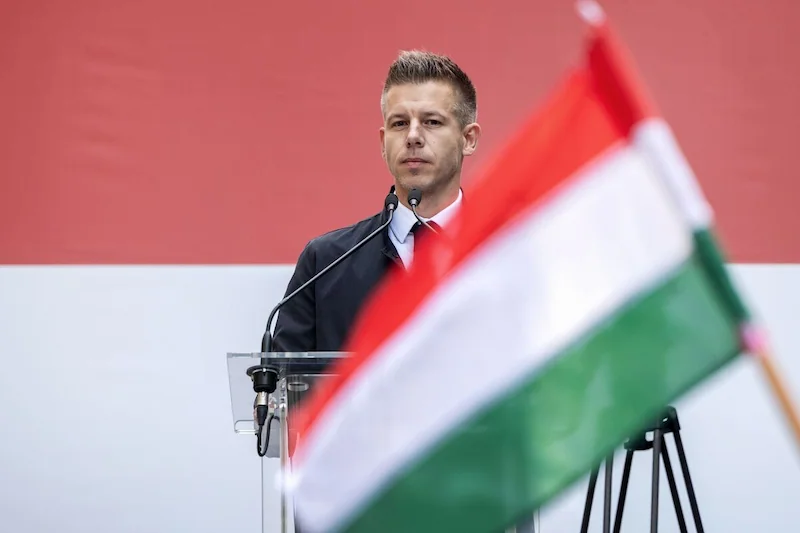


In a surprising twist of events on the Hungarian political scene, Peter Magyar, a newcomer who recently joined the Tisza party, has swiftly risen to prominence as the leading opposition figure challenging Prime Minister Viktor Orban. Magyar, a 43-year-old lawyer and former diplomat, has captured the attention and support of the Hungarian public through his advocacy for strengthening the rule of law and realigning the country with European values. His rapid ascent to popularity has outshone established opposition parties, with Tisza garnering a significant 24% support among decided voters, according to a recent Median poll published on HVG news website.
Renowned for his role as a whistleblower and for spearheading large-scale anti-government protests, Magyar has struck a chord with citizens disillusioned with corruption and the perceived authoritarianism of Orban's administration. His appeal stretches beyond traditional party lines, drawing in supporters from diverse political backgrounds.
Magyar's political debut came during a moment of crisis within the ruling party, when a scandal involving a presidential pardon exposed internal rifts and led to the downfall of two high-ranking Orban allies, including Judit Varga, Magyar's former spouse and a prominent Fidesz figure. Since then, Magyar has embarked on a nationwide campaign tour, attracting sizable crowds in regions traditionally loyal to Orban’s Fidesz party.
Despite Orban's firm grip on power and the government's dismissal of Magyar as a viable threat, the upstart politician continues to gain momentum, leveraging social media to connect with a broad audience and rally support. Critics have attempted to paint Magyar as a product of the very regime he seeks to challenge, citing his past associations with state institutions. However, his ability to resonate with disenfranchised voters and effectively communicate his vision for a more transparent and accountable government has propelled him into the spotlight.
As Magyar prepares for his upcoming rally in Debrecen, a stronghold of Fidesz in eastern Hungary, all eyes are on whether his grassroots movement can translate into tangible electoral success. With the June elections looming on the horizon, the political landscape in Hungary stands at a crossroads, teetering between continuity under Orban's dominance and the potential for a seismic shift led by a fresh face in Hungarian politics.