


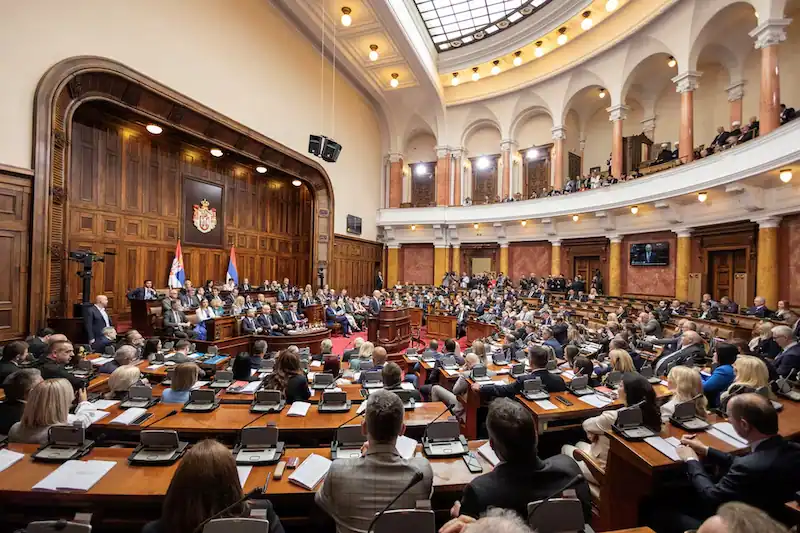


In a significant development, the Serbian parliament has given the green light to a coalition government spearheaded by newly appointed Prime Minister Milos Vucevic. Describing it as a "government of continuity," Vucevic highlighted the crucial role this coalition will play in navigating the various geopolitical challenges facing the Balkan nation, particularly tensions with Kosovo. This coalition government comprises ministers primarily from the ruling Serbian Progressive Party (SNS), which emerged victorious in the national election held last December. Additionally, it includes representatives from five smaller parties that constitute the ruling coalition, with a notable third of the ministers being newcomers to the political arena.
The composition of the 31-member government, approved by 152 deputies out of the 250-seat parliament, signals a blend of experience and fresh perspectives. However, it has not been without controversy, as it includes two politicians sanctioned by the U.S. for corrupt activities and a leader from a far-right party that did not secure adequate votes to enter parliament. Despite these criticisms, Vucevic, a staunch ally of President Aleksandar Vucic, emphasized that this government would largely uphold the policies of its predecessor.
Foremost among the challenges facing Serbia is the ongoing conflict regarding Kosovo, a contentious issue that has long strained relations with the region since its declaration of independence in 2008. Vucevic underlined the government´s commitment to advancing Serbia's territorial integrity while balancing its diplomatic relations with countries like Russia, China, and its aspiration to join the European Union. Balancing these diverse interests calls for deft diplomatic maneuvers, especially as Serbia braces for a visit by Chinese President Xi Jinping in May.
In his address to lawmakers, Vucevic outlined key policy priorities, including bolstering national security by proposing a mandatory four-month military service. Moreover, he articulated an ambitious economic vision, aiming to elevate Serbia’s GDP from its current 69.5 billion euros to 94.2 billion euros by 2027. Despite external pressures, Vucevic affirmed Serbia's stance on issues like Russia's invasion of Ukraine, emphasizing the country's commitment to an independent foreign policy.
While the formation of this coalition government has sparked debates and drawn scrutiny, its tenure holds immense significance for Serbia's future trajectory. As the nation charts its course amidst geopolitical complexities and internal challenges, the unity and efficacy of this government will be closely monitored both domestically and on the international stage.