


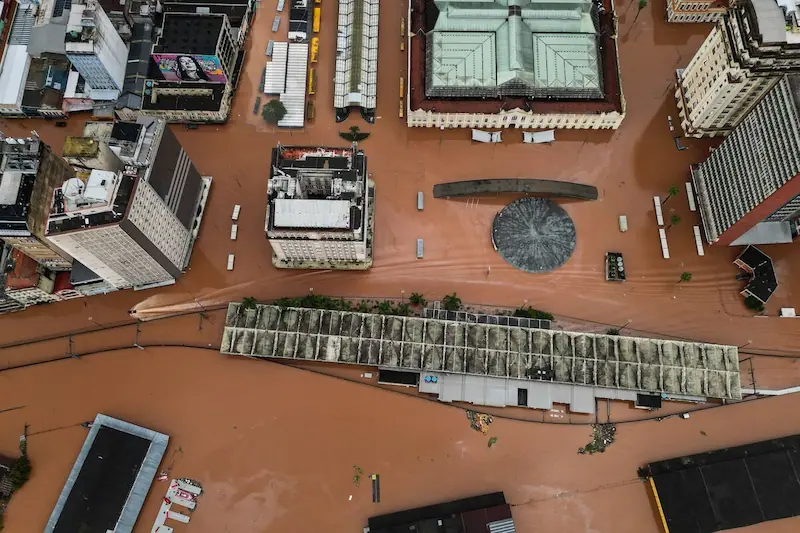


In Southern Brazil, the devastating floods and heavy rainfall are wreaking havoc on the region's vital agricultural sector and economy, sending shockwaves across various industries. The southernmost state of Rio Grande do Sul has been hit particularly hard, with entire cities submerged and the main airport shut down indefinitely due to the deluge that began on April 28. The impact is staggering, with over 400 municipalities and 1.5 million people affected, 164,000 residents displaced, and a tragic death toll of 100 people.
Preliminary economic estimates from Enki Research already suggest a significant impact of at least $2.5 billion in Rio Grande do Sul alone. This figure is expected to rise as water levels remain high, and more storms are forecasted in the region in the days ahead. The damage encompasses physical infrastructure, agriculture, and substantial losses in business revenue that may take months to recover. Chuck Watson from Enki Research warns that the situation could worsen as more rain is expected, prolonging the crisis.
The initial repercussions are already being felt in the agricultural sector, with soybean prices surging amidst concerns about reduced harvests and declining quality. President Luiz Inácio Lula da Silva has even raised the possibility of Brazil needing to import rice and beans, as Rio Grande do Sul accounts for a significant portion of these staples in the national diet. The state's pivotal role in meat production is also threatened, with approximately 17% of the country's pork and 13% of poultry coming from the region.
Leading agricultural companies like Tres Tentos Agroindustrial SA and rice producer Camil Alimentos SA are grappling with the fallout. Tres Tentos Agroindustrial SA’s shares have plummeted over worries about operational impacts, while Camil Alimentos SA faced challenges in harvesting its crops. Despite logistic hurdles, Camil Alimentos SA managed to maintain the supply of rice and beans, offering a glimmer of resilience in the face of adversity.
The financial sector is bracing for turbulent times ahead, with banks likely to renegotiate debts for the agricultural industry by extending durations and reducing interest rates. Banks with significant exposure to Southern Brazil, such as Banrisul, are particularly vulnerable. Once Banco do Estado do Rio Grande do Sul SA, Banrisul has around 85% of its loans tied to the region, making it a focal point of concern. Shares of Banrisul have dipped amidst uncertainties, and the bank is striving to assist clients during this challenging period.
Manufacturing and utilities sectors are also grappling with the aftermath of the calamity. Gerdau SA and General Motors have halted operations, affecting a portion of their steel and automotive production capacities. Utilities like Eletrobras and CPFL Energia SA are facing shutdowns and revenue losses due to disruptions in power generation and transmission. The financial toll of these disruptions is substantial, highlighting the widespread impact of the floods on various industries.
As companies assess the full extent of the damage, uncertainty looms over the path to recovery. While some, like Tres Tentos, report normal operations, others such as Gerdau are awaiting safer conditions to resume activities. With significant implications for the economy, credit institutions like Banco do Brasil SA and Banco ABC Brasil SA, along with brokerage firm XP Inc, are closely monitoring the situation. As Southern Brazil grapples with the aftermath of these catastrophic floods, the road to recovery appears challenging, requiring collective resilience and support across sectors to rebuild and overcome the crisis.