


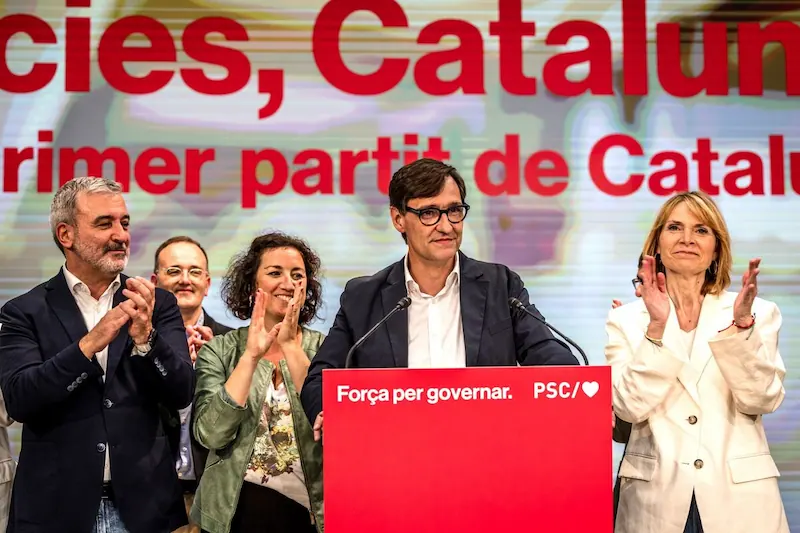


The recent local elections in Catalonia have shaken up the political landscape both in the region and in Madrid, sending ripples of uncertainty through both arenas. Spanish Prime Minister Pedro Sanchez's Socialist party, under the leadership of regional candidate Salvador Illa, secured a historic victory by winning both the popular vote and a significant number of seats. This marks a turning point in Catalonia's political history, as it is the first time in over a decade that a non-separatist party has emerged victorious in the region.
However, with Illa falling short of an absolute majority, the path to forming a coalition government is fraught with challenges. This outcome sets the stage for intense negotiations among the parties in the coming weeks, with a potential investiture vote on the horizon. The possibility of an alliance between disparate political factions looms large, with the fate of Catalonia's governance hanging in the balance.
The election results also revealed a setback for the pro-independence movement, as the nationalist parties failed to secure a majority in the regional parliament for the first time in forty years. Junts, led by fugitive leader Carles Puigdemont, emerged as the largest separatist party, while its rival ERC faced a decline in support. This fragmentation within the pro-independence camp further complicates the formation of a stable government in Catalonia.
Sanchez's conciliatory approach towards Catalonia, characterized by offering amnesty to those involved in the illegal independence referendum of 2017, seems to have gained traction with voters. However, the political landscape remains precarious, with the looming possibility of legislative deadlock at both the regional and national levels. The strained relationships between key political players, such as Puigdemont and the ERC leadership, add another layer of complexity to the situation.
The increased turnout in the elections signifies the significance of the issues at stake for the people of Catalonia. While the right-wing parties, such as the People's Party and Vox, gained ground in the election, their opposition to the proposed amnesty law adds another layer of tension to the political landscape.
In conclusion, the outcome of the Catalonian elections sets the stage for a period of intense negotiations, uncertainty, and potential political realignments. The delicate balance of power, both regionally and nationally, hangs in the balance, with the fate of Catalonia's governance and its relationship with Madrid at a critical juncture.