


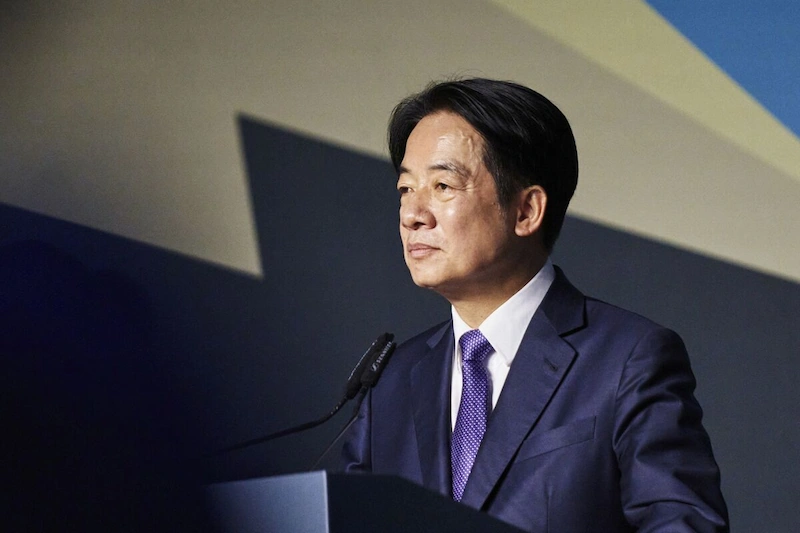


Taiwan stands on the brink of a significant transition as it prepares to inaugurate Lai Ching-te as its new president. With 24 million inhabitants, Taiwan holds a pivotal position in the global landscape as a key player in chip manufacturing. As Lai takes the oath of office on Monday, all eyes turn to the island nation, especially key US policymakers who are closely monitoring the event. A group of former officials from the US is even flying in for the occasion, highlighting the strategic importance of Taiwan in US-China relations.
Lai Ching-te, a 64-year-old physician and the current vice president, won the recent election with a clear stance on maintaining Taiwan's independence from China. Throughout his campaign, Lai aligned himself closely with the policies of outgoing President Tsai Ing-wen, emphasizing Taiwan's de facto sovereign status and the need to bolster military capabilities to uphold the status quo in the Taiwan Strait. However, Lai's approach towards China could shift depending on Beijing's reaction, considering China's claims over Taiwan as its territory.
According to Steve Tsang, director of the SOAS China Institute in London, Lai is expected to follow Tsai's balanced approach initially but may adjust his strategy in response to Beijing's actions during his term. How Lai navigates the complex dynamics with China will be crucial in shaping the future of US-China-Taiwan relations.
The first day of Lai's presidency holds significant importance, as past experiences have shown that initial interactions can define the tone of relations with China. Tsai's inauguration speech in 2016, where she expressed willingness for direct talks with Beijing without conceding to China's terms, was met with criticism from Beijing. This contrasted sharply with the approach China took towards Tsai's predecessor, Ma Ying-jeou, who engaged in talks with President Xi Jinping before leaving office.
Lai has emphasized a platform of "peace, parity, democracy, and dialogue" as the foundation for cross-strait relations. He aims to maintain stability and principled engagement with China while safeguarding Taiwan's interests. Despite expressing openness to dialogue with China based on mutual respect, Lai faces the challenge of China's hardline stance on Taiwan's independence and its military posturing in the region.
As Lai assumes office with a narrower electoral mandate compared to Tsai, he also faces the task of managing a legislature dominated by the opposition Kuomintang party. This presents additional challenges in implementing his agenda and navigating Taiwan's complex political landscape.
The future of Taiwan holds significant implications for global economic stability and regional security. The potential escalation of tensions between the US, China, and Taiwan could have far-reaching consequences on supply chains, economic growth, and geopolitical dynamics. Aware of these risks, Lai has positioned himself as a steady leader committed to upholding Taiwan's democratic values in the face of external pressures.
With US support for Taiwan strengthening under the Biden administration, Lai's tenure as president will play a crucial role in shaping the trajectory of US-China-Taiwan relations. By emphasizing optimism and hope in the face of coercion from Beijing, Lai signals his resolve to protect Taiwan's democratic freedoms while navigating the complexities of regional geopolitics.