


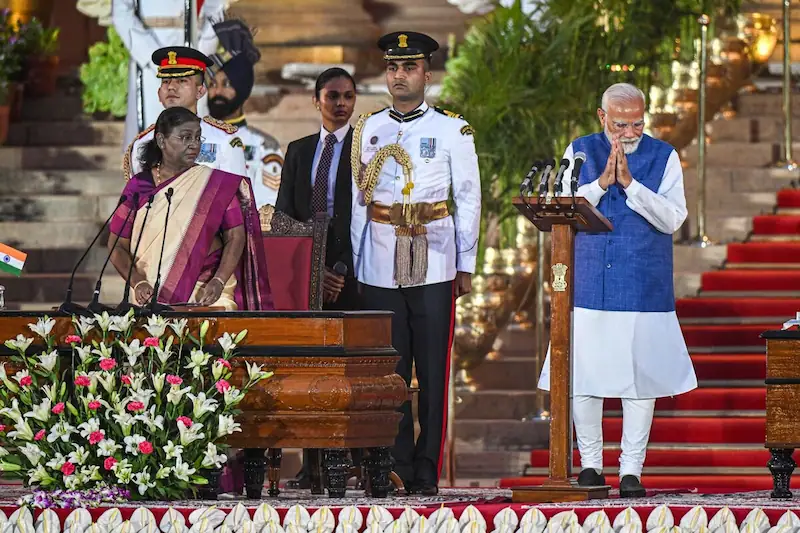


Prime Minister Narendra Modi took the oath of office for a historic third consecutive term on Sunday, solidifying his leadership for another five years despite facing a challenging election that forced him to form a coalition government for the first time. The ceremony, held at the president's residence in New Delhi and attended by a diverse array of guests including regional leaders, business figures, and celebrities, marked the beginning of a new chapter in Indian politics.
Accompanying Modi were several ministers from his previous cabinet, including key allies such as Amit Shah and Rajnath Singh, who also reaffirmed their commitment to serve the nation. However, the distribution of portfolios among these ministers is yet to be disclosed, raising anticipation and speculation about the future direction of the government.
The recent power dynamics within the Bharatiya Janata Party (BJP) became evident following the party's loss of a clear majority in the parliament, necessitating a collaborative approach to governance. Despite this setback, Modi's return as prime minister signifies a continued era of economic growth and development, with a focus on addressing pressing issues such as unemployment and inflation.
As the second prime minister in India's history to achieve three consecutive terms, Modi faces the dual challenge of meeting the aspirations of a diverse population while balancing the demands of coalition partners. This shift towards a more inclusive governance model reflects a broader trend in Indian politics towards cooperative leadership and consensus-building.
Analysts have highlighted the potential benefits of a Modi-led government that embraces coalition politics, citing greater accountability and representation for various segments of society. With a renewed mandate and a revised approach to governance, India is poised to navigate complex economic and social challenges under Modi's leadership, signaling a new chapter in the country's political landscape.