


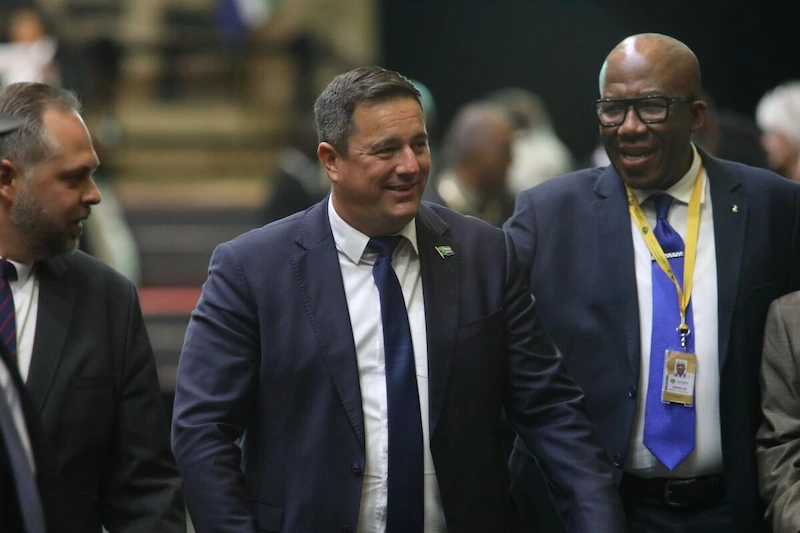


In a historic move, the African National Congress (ANC) and the Democratic Alliance (DA) of South Africa have come together to form a government of national unity with a shared focus on driving "rapid, inclusive, and sustainable" economic growth. The accord was signed in Cape Town, laying out 11 key priorities for the incoming administration, with economic revival taking the top spot.
Acknowledging the stagnant growth of the South African economy, which has struggled to keep pace with population growth, the agreement emphasizes the need for increased fixed capital investment, structural reforms, and fiscal sustainability. With the country's unemployment rate soaring to 33% in March and income inequality ranking among the highest globally, the urgency to address these challenges is paramount.
Speaking at the event in Cape Town, DA leader John Steenhuisen stressed the long-term commitment required to tackle South Africa's economic woes, cautioning that progress will not be immediate. The upcoming administration faces an arduous task of navigating through deep-rooted issues that have plagued the nation for years.
With the ANC losing its parliamentary majority for the first time since 1994, the decision to form a unity government reflects a pragmatic approach to governance. Alongside the ANC and DA, other parties such as the Inkatha Freedom Party and the Patriotic Alliance have pledged their support, indicating a broader coalition effort in the country's political landscape.
While the agreement lays down fundamental principles for collaboration, the real test lies in the formation of a cabinet, where opposition parties are vying for influential positions. Although President Cyril Ramaphosa retains the authority to appoint cabinet members, consultations with the coalition partners are mandated, signifying a departure from traditional political dynamics.
Looking ahead, a national dialogue involving business and civil society stakeholders is on the horizon as part of the alliance's plan to engage a diverse range of voices in shaping the country's future. As South Africa embarks on this unprecedented journey of political cooperation, the promise of a revitalized economy and a more equitable society hangs in the balance.