


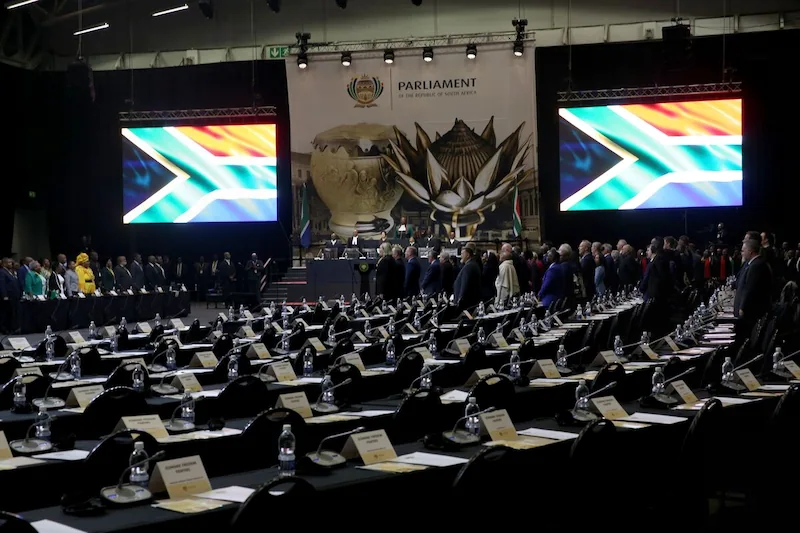


In a landmark development, ten South African political parties have come together to forge a ruling alliance, marking the initiation of a government of national unity set to govern the country for the next five years. The decision was finalized with the inclusion of the Al Jama-ah party, who joined forces with nine other parties in this historic collaboration. Notably absent from this coalition are the leftist Economic Freedom Fighters and former President Jacob Zuma’s uMkhonto weSizwe party, despite their significant voter support in the recent elections.
The African National Congress, the leading party in this government, emphasized that any further inclusion of parties into the alliance will require the consent of the founding members. However, it also highlighted ongoing discussions with non-participating parties to explore potential avenues for collaboration in the future.
This move towards a government of national unity became necessary as the ANC lost its parliamentary majority for the first time in three decades during the recent elections, securing 40.2% of the vote. The centrist Democratic Alliance closely follows with 21.8%, collectively giving the coalition parties a commanding 287 seats out of 400 in parliament.
The composition of the new cabinet is currently under deliberation, with the ANC indicating that the structure will be announced in the coming days. Investors are eagerly observing these developments, hopeful for an uptick in economic reforms under this more centrist-leaning government. Already, the local currency has seen a 4.6% strengthening this month, coupled with favorable movements in bonds and stocks.
South Africa’s National Treasury has affirmed its commitment to the fiscal trajectory outlined in the 2024 budget, aimed at stabilizing public finances, reducing fiscal risks, fostering growth, and aiding vulnerable populations. The incoming administration is expected to bring forward additional policy perspectives and strategies, although adherence to the current fiscal strategy is deemed critical for the interim period. The Treasury envisions a budget for the upcoming year that will aim to attain a debt-stabilizing primary surplus by the 2025-26 fiscal year, decrease the budget deficit to pre-pandemic levels, and stabilize debt-service costs as a percentage of revenue.
As South Africa ventures into this new era of collaborative governance, the eyes of the nation, investors, and global spectators remain fixed on the unfolding narrative of unity, reform, and prosperity.