


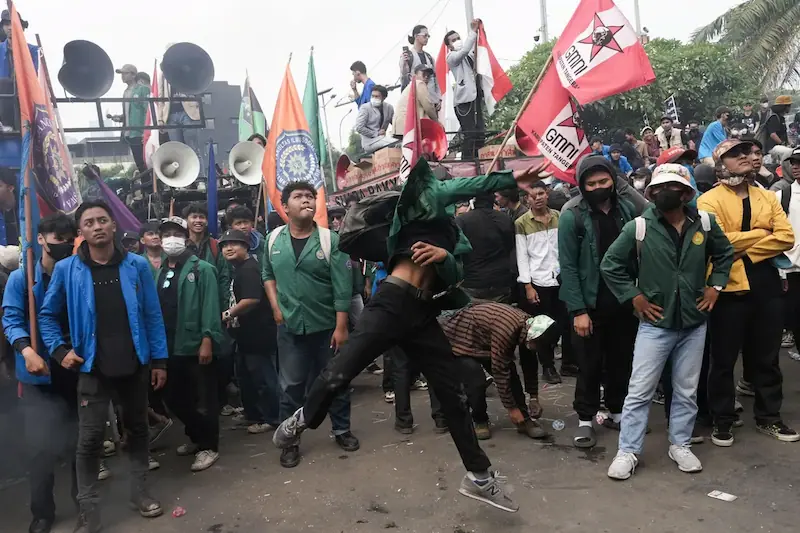


Indonesian legislators have reversed their course on proposed changes to regional election laws following widespread protests that reverberated across the nation, causing turbulence in financial markets. The revisions, which stirred public outcry, would have potentially paved the way for President Joko Widodo's youngest son to enter a gubernatorial race, while also facilitating the dominance of allies of both the outgoing leader and President-elect Prabowo Subianto in elections in key provinces like Central Java and Jakarta.
Deputy Speaker of Parliament Sufmi Dasco Ahmad disclosed in a statement on Thursday that the government has scrapped its plans to amend the laws and will respect the recent ruling by the Constitutional Court. As a result, there are no immediate plans for a parliamentary session to discuss the legislation further. "Absolutely nothing. I can assure you, nothing," he emphasized.
However, despite this announcement, concerns persist that lawmakers may still attempt to push through the proposed changes. Parliament has a narrow window to approve the amendments before the commencement of candidate registration for the upcoming gubernatorial and vice-gubernatorial elections. Sufmi suggested that the revision of the regional election law could be revisited by the incoming parliament to address certain areas that require refinement.
The decision to retreat from the controversial legislation comes in the wake of extensive protests that engulfed major cities in Indonesia, leading to market turmoil. The rupiah experienced a notable decline of 0.7%, marking its sharpest drop in two months and positioning it as the weakest performer among major Asian currencies. Concurrently, the benchmark stock index witnessed a 0.9% decline.
The public outcry, both offline and on social media platforms, echoed a collective sentiment that the current administration's efforts were undermining the Constitutional Court's ruling which upheld age restrictions and allowed smaller political parties to participate in the upcoming regional elections. This ruling effectively thwarted the aspirations of Jokowi's youngest son to run for governor or vice-governor due to age constraints.
Pro-democracy activists view the abrupt reversal by the government as a significant victory. They have criticized President Jokowi for potentially jeopardizing the democratic fabric of the country in pursuit of solidifying a political dynasty and ensuring the continuity of his policy agenda, notably the development of a new $30-billion capital city.
The recent spate of events, including the attempt to revise the regional election laws, has intensified the discontent and frustration among critics, who argue that these maneuvers are designed to extend Jokowi's influence beyond his term, which concludes in October after serving two consecutive five-year terms. Today's protests, which resonated across various Indonesian cities, culminated in a forceful demonstration outside the parliament building in Jakarta, where protesters breached the barricades and clashed with authorities.
In response to the escalating unrest, parliamentary deputies subsequently announced the abandonment of the controversial revisions. The President's office earlier affirmed its commitment to abide by the court's decision in the absence of changes to the law, emphasizing Indonesia's dedication to upholding freedom of speech and democratic principles. Social media platforms became inundated with calls to safeguard the Constitutional Court's ruling under the hashtag #KawalPutusanMK, underscoring the populace's commitment to defending Indonesia's evolving democracy.