


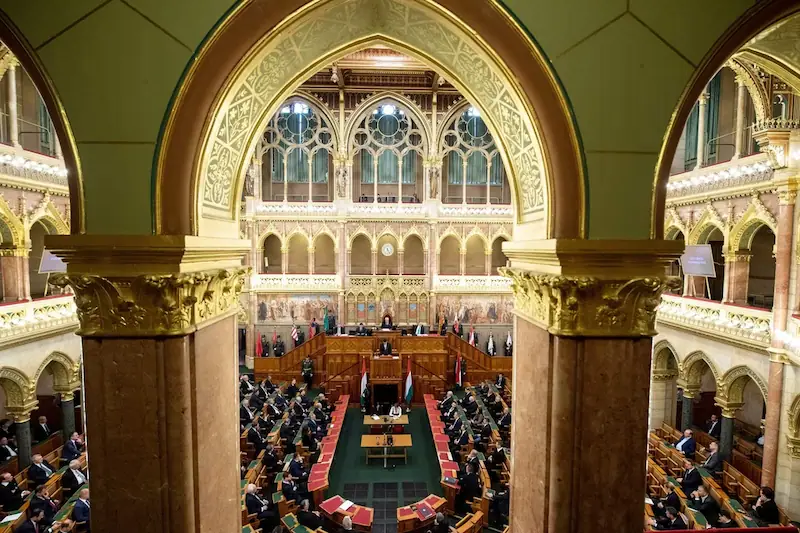


Hungary's parliament has granted Prime Minister Viktor Orban a six-month extension of his rule-by-decree, further solidifying his centralized power and escalating tensions with the European Union. The decision allows Orban to continue issuing decrees and bypassing regular parliamentary procedures until May of next year.
With his Fidesz party holding a significant majority in the Hungarian legislature, the decree rule enables Orban's government to push through legal changes swiftly, reinforcing the leader's efforts to eliminate checks and balances on his power. This move comes as the EU withholds billions in funding earmarked for Hungary due to concerns over the rule of law.
The state of emergency in Hungary has been a recurring theme since 2016, initially declared during the migration crisis and expanded in 2020 due to the Covid-19 pandemic. Amendments to the constitution in 2022 further broadened the government's authority, linking decree rule to situations like the ongoing conflict in Ukraine.
Critics, including civil society groups like Amnesty International, have condemned the state of emergency laws as tools used to erode democratic principles and concentrate power in the hands of a few. The government's abuse of these laws extends beyond emergency situations, impacting governance in various areas unrelated to the stated emergencies.
In a separate development, Hungary's parliament has modified legislation governing public universities, restricting senior politicians, including Orban's ministers, from leading university foundations and imposing term limits on trustees. Earlier legislation had led to EU sanctions that suspended Hungarian universities from the Erasmus program and excluded university researchers from EU-funded projects.
As Hungary extends Orban's rule-by-decree and implements significant changes to university governance, the country's relationship with the European Union remains strained, reflecting broader concerns over democracy and the rule of law within the bloc.